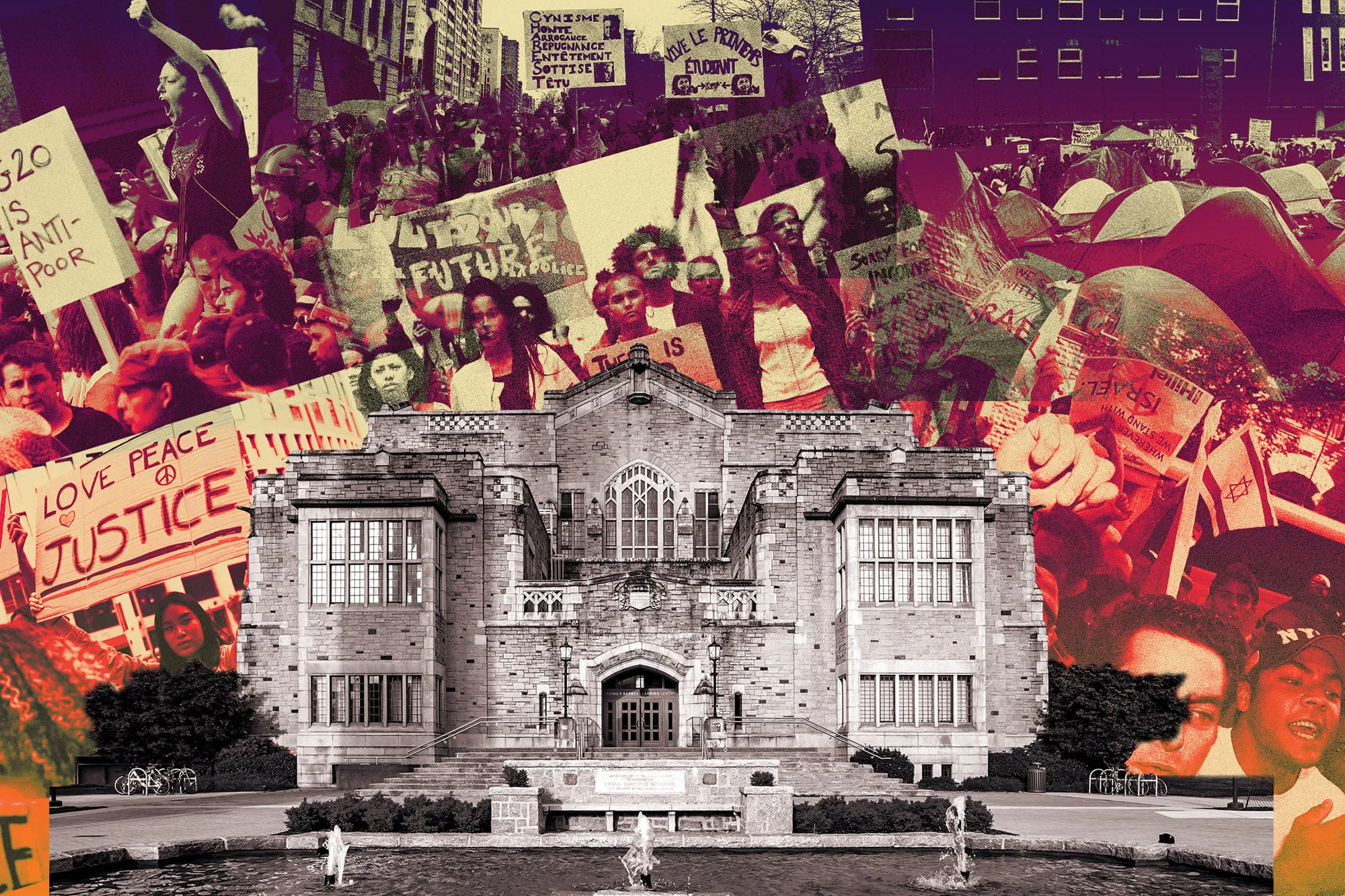
The Battle for the Soul of the University
In early 2020, as the world was shutting down, the X̱wi7x̱wa Library at the University of British Columbia released a manual for instructors who were moving classes online. It mainly contained material you’d expect to see: links to digitized books and guides to remote-teaching strategies. It ended with suggestions for giving virtual land acknowledgments, which it defined as “respectful, yet political” declarations recognizing “the colonial context of the Indigenous territory/territories where a gathering is taking place.”
For years, land acknowledgements have been a part of the ceremonial architecture of campus life. And for many academics, they’re uncontroversial. Their purpose is to highlight a discomfiting reality: Canada, the model liberal nation, was built on a legacy of violent dispossession. This fact feels especially salient at UBC, where the main Vancouver campus is on Musqueam territory and the satellite Okanagan campus is on the home of the Syilx people. But a smaller cohort of academics have long viewed land acknowledgements as virtue signalling, a cheap way for speakers to shore up their progressive bona fides without improving Indigenous people’s lives.
For Andrew Irvine, a philosophy professor at the Okanagan campus, land acknowledgements represent something even worse: political declarations which, when delivered by the university, undermine the sacrosanct principle of institutional neutrality. This principle ensures that students and faculty members have the freedom to express their ideas and opinions—and that the university is an apolitical forum for that expression. When administrators at UBC give land acknowledgements, they often refer to Musqueam or Syilx territory as “unceded,” suggesting, to Irvine, that the Canadian state lacks legitimacy on the territory. The library guide contained more statements that seemed, to him, baldly political: “Don’t sugarcoat the past,” it read. “Use terms like genocide, ethnic cleansing, stolen land and forced removal.”
Irvine believes that provocative ideas—like the notion that Canada is an illegitimate, genocidal state—should be permitted on campus almost unconditionally when expressed by students or professors. But when the administration itself states an opinion, it signals which ideas will and will not be treated approvingly. He thinks that this kind of institutional favouritism should be anathema at a liberal university, where free debate is supposed to flourish.
Related: These International Students Wanted Citizenship. Canada Killed That Dream.
Irvine is a greying, bespectacled man with a widow’s peak and a preference for tweedy suits. He looks like the stereotype of a philosophy professor, and he’s fascinated by renegade thinkers. He’s written a play about Socrates, who was executed for speaking his mind, and edited a monograph on Bertrand Russell, the British intellectual whose commitment to pacifism during the First World War got him dismissed from Cambridge University and later imprisoned. He’s also written admiringly of David Saxon, a University of California physicist who was fired during the McCarthy era for refusing to sign an anti-communist oath.
BLACK FRIDAY SALE
Our best Black Friday offer of the year: one year for $29.99. Don’t miss it.
SUBSCRIBE NOW

This spring, Irvine embarked on his own campaign against campus orthodoxy. In April, he filed a lawsuit against UBC, alleging that it had violated B.C.’s University Act, a provincial statute from 1890 that requires the school to be “non-sectarian and non-political in principle.” In preparation, he created a dossier of statements by the university that in his opinion lay outside the boundaries of acceptable speech for an academic institution. Irvine noted instances—including the library guide from 2020—in which administrators had given land acknowledgements or encouraged faculty to do so. He compiled statements on Israel-Palestine, like one by the Okanagan Senate, a board that manages academic affairs, condemning “the perpetration of genocide” by Israel. He pored over job descriptions for tenure-track positions. In many, he noted, the hiring committee seemed to indicate that it would evaluate candidates based on fealty to progressive ideals. One posting at the faculty of medicine required applicants to affirm belief in “anti-racism, equity, diversity, decolonization, Indigenization and inclusion.” This demand felt to him like a left-wing counterpart to anti-communist loyalty pledges in the ’50s.
Irvine enlisted like-minded colleagues to compile their own documents, including political scientists Christopher Kam and Brad Epperly; Michael Treschow, an English professor with a love of Tolkien; and Nathan Cockram, a philosophy graduate student. On April 7, the group filed their dossier at the Supreme Court of British Columbia along with a petition asking the court to prevent university administrators from giving or encouraging land acknowledgements, making statements on Israel-Palestine or requiring job applicants to support DEI.
As of this writing, the university has not filed its response, but it will likely argue that the petitioners have misrepresented the University Act—that the phrase “non-sectarian and non-political,” simply means unaffiliated with a church or political institution. By this logic, the act prevents the university from endorsing, for example, the Liberal Party or the Archdiocese of Vancouver. But it has nothing to do with land acknowledgements or DEI.
Other parties have already sharply criticized the petition. Don Tom, vice-president of the Union of British Columbia Indian Chiefs, argued that by questioning land acknowledgements, Irvine and his fellow petitioners were condemning the very notion of Indigenous sovereignty. “There is absolutely no academic value in debating the validity of First Nations’ basic human rights,” he stated in a press release.
The BC Civil Liberties Association pointedly declined to support the petition. Liza Hughes, chair of the organization, weighed in on the BCCLA’s website: “Acknowledging that you are on unceded land is no more political than refusing to do so. Muzzling faculty will not advance academic freedom.” Her message to the petitioners was clear: as free-speech advocates, they misunderstood the cause they claimed to champion.
The debate is a symptom of a bigger crisis in higher education, and in society at large. Academia once affected a degree of aloofness from daily political life. University administrations often refrained from taking positions on hot-button issues. Many believed that shaping public opinion wasn’t their job. Today, university presidents, deans and vice-deans routinely issue statements on whatever topics are dominating the headlines or trending on social media. Often, these statements have a progressive bent; that’s one reason why universities now have a reputation as incubators of leftist thought.
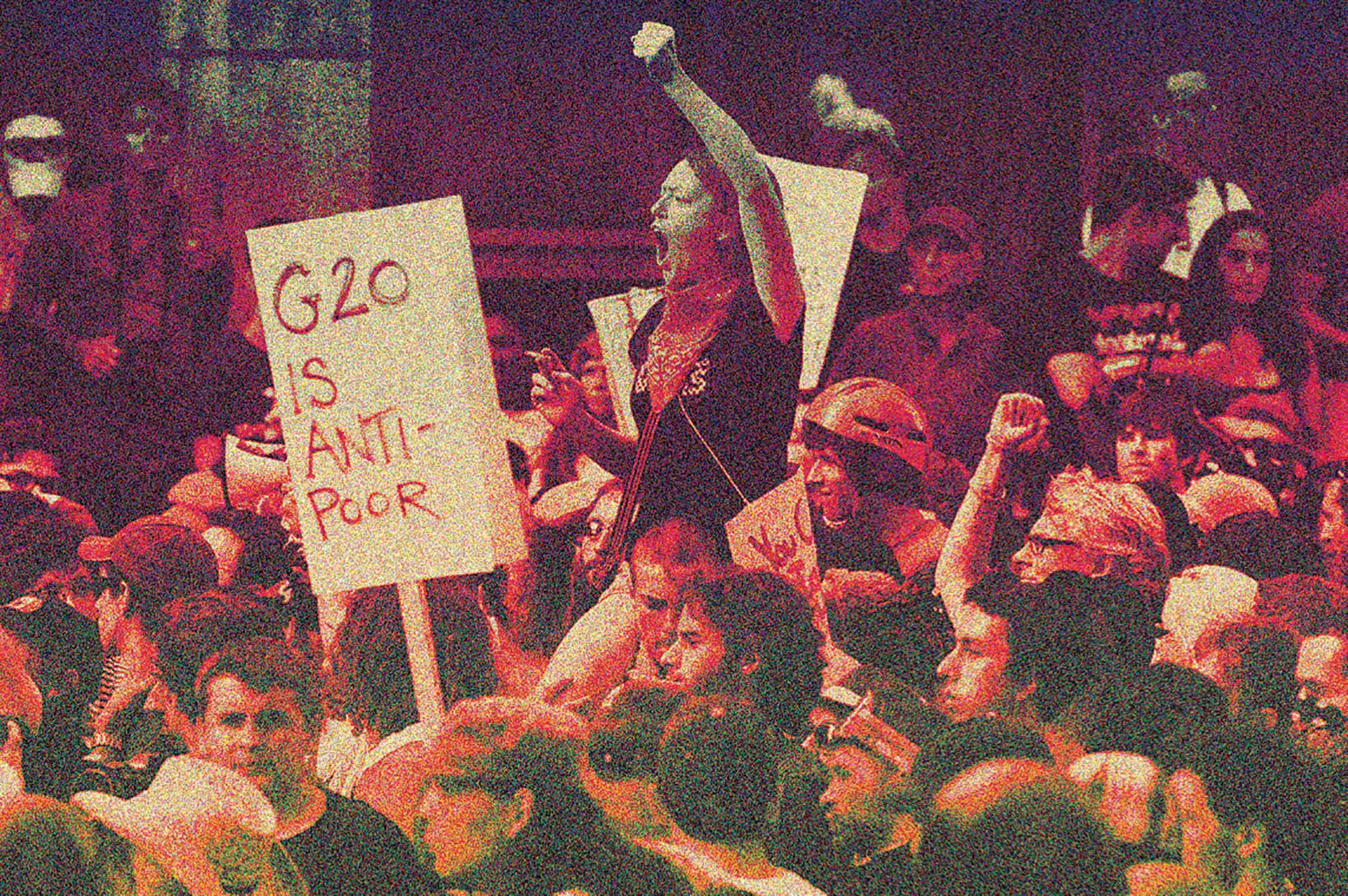
Whether you view this trend as laudable, defensible or embarrassing depends on your politics—and on your understanding of why universities exist in the first place. Should they serve as engines of social justice, or spaces of independent inquiry? Can they be both? And what does all of this mean for intellectual freedom, an increasingly fraught concept? Canada’s universities are facing multiple crises, including severe financial strain and freefalling public confidence. How they answer the urgent questions before them will determine a great deal about how—and if—they can recover.
I’ve been enmeshed in the university system my entire adult life, first as a literature student at McGill in the late 2000s and then as a writing instructor at the University of Toronto, where I’ve worked since 2012. I know that, even at the best of times, universities can be rancorous, dysfunctional places. Right now, though, things are messier than they’ve been in decades. The system is straining under multiple pressures.
First and foremost is a crisis of legitimacy. Data from the Canadian Association of University Teachers show that 60 per cent of Canadians believe post-secondary degrees are less valuable than they once were. Only 15 per cent have “a great deal” of confidence in the higher education system, compared to 28 per cent with little to no confidence. And as CBC journalists and Canada Post mail carriers already know, an unpopular public service is at high risk for political interference and overall turbulence. The crisis in confidence, in turn, is exacerbating other problems, including universities’ growing financial precarity. Over the past 10 years, many provincial governments froze both tuition fees and grants to post-secondary institutions. To make up the revenue shortfall, universities threw open their doors to international students, who pay inflated fees. This arrangement worked well until last year, when the federal government slashed student visas, first by 35 per cent and then by an additional 10 per cent. The sector is now in a financial tailspin. The University of Waterloo is shouldering a $95-million deficit. At York University, the deficit is $111 million. Hiring freezes are under way at the University of Winnipeg, Simon Fraser, McGill, Queen’s, Dalhousie and Memorial. Laurentian University is selling off properties to avoid insolvency and appease creditors.
The combination of declining public trust and financial strain has made universities easy political targets. During the 2025 election campaign, Pierre Poilievre pledged to reduce funding to universities unless they “end the imposition of woke ideology.” Alberta Premier Danielle Smith is threatening to withhold grants until universities become more politically balanced; she told one reporter that journalism schools, for example, should produce equal numbers of liberal and conservative commentators. Quebec Premier François Legault has doubled tuition fees for out-of-province students, a move that seems intended to crush English-language institutions. And Nova Scotia Premier Tim Houston has threatened to cut universities’ funding unless they better align research with the government’s economic priorities in life sciences, energy and infrastructure.
Related: Why Gen Z Will Never Leave Home
It’s tempting to blame political leaders for attacking universities, but politics is downstream from culture. Politicians clearly believe that there’s a market among voters for their provocations. The trend is more pronounced in the U.S., where Donald Trump is waging a campaign of extortion against the Ivy Leagues. To restore federal funding, Columbia recently paid $200 million to settle a questionable lawsuit brought by Trump’s justice department.
Declining popularity isn’t just a problem for the academy; it’s the problem. In a hypothetical world where Canadians held universities in higher esteem, we’d see fewer accusations of bias, fewer funding cuts and fewer threats of further cuts to come. Restoring public confidence is clearly the academy’s top priority.
But how can this be done? One solution is for universities to redouble their commitment to social justice. Proponents of this argument point out that we live in a fractured, polarized society. By healing the world, they posit, universities can heal themselves: Canadians will start believing in the academy when they see it as an ally in the fight for climate justice, economic redistribution, Indigenous sovereignty and the liberation of Palestine. In 2023, Jennifer Simpson, a provost at Toronto Metropolitan University, wrote a piece in the web publication The Conversation arguing for greater government funding of universities. “I contend that the central contribution of post-secondary institutions, related to graduate and undergraduate education,” she wrote, “is to prepare students to attend to the practices of living together well—with the capacities to recognize inequity and advance equity.”
Other people think this idea gets things exactly backwards. This attachment to social justice isn’t the solution to the academy’s problems; it’s the cause. According to this argument, ordinary people perceive the academy as an elite, self-serving interest group, hostile to political diversity. That’s why they distrust it. Members of this camp believe that when the academy binds itself to social-justice ideals—and when it defines those ideals in narrowly partisan terms—it undermines both public confidence and its higher mission, which is to seek knowledge with an open mind. To save themselves, universities must commit to institutional neutrality. This is the school of thought to which Irvine and his fellow petitioners belong.
To fully understand Irvine’s argument, consider the dinosaurs. Most experts think their extinction was due to a meteorite that slammed into Mexico’s Yucatan Peninsula 66 million years ago. But some paleontologists favour an alternative explanation: a series of massive volcanic eruptions in the Deccan Traps, in what is now India, which gradually poisoned the atmosphere. There are credentialed researchers on both sides of the debate. They tend to hate each other.
Imagine if, one day, the president of Stanford University, an economist with no expertise in paleontology, suddenly announced that the school was endorsing the Yucatan meteorists against the Deccan volcanists. If you were a Deccan volcanist at Stanford, you might wonder, every time you were passed over for a promotion, if the school was punishing you for your dissenting viewpoint. Worse, what if you didn’t have tenure? What if you were a part-time lecturer, desperate for one of a few full-time jobs? Would you really stick to your guns on Deccan volcanism, jeopardizing your financial security? More likely you’d self-censor, which academics are never supposed to do. The point of institutional neutrality, proponents claim, is to eliminate incentives that favour conformity.
The idea that neutrality fosters intellectual freedom was most famously articulated in 1967 by Harry Kalven Jr., a law professor at the University of Chicago. His campus had been rocked by demonstrations on issues like drug legalization and the Vietnam War. The university’s president, George W. Beadle, struck a committee, led by Kalven, to consider how the university should engage the protestors. Kalven’s advice: it shouldn’t. He asserted that free debate is sacrosanct, but it’s most likely to happen when the institution minds its own business, neither supporting nor condemning anyone. “The university is the home and sponsor of critics,” Kalven wrote. “It is not itself the critic.”
The school incorporated Kalven’s notion of institutional neutrality into its code of conduct. For academics at other campuses, the principle became a north star, a standard for how administrators might respond to political pressures. At its core was a classically liberal notion: neutrality is another word for fairness. Your right to speak is inseparable from your opponents’ right to do so, even if you despise what they say.
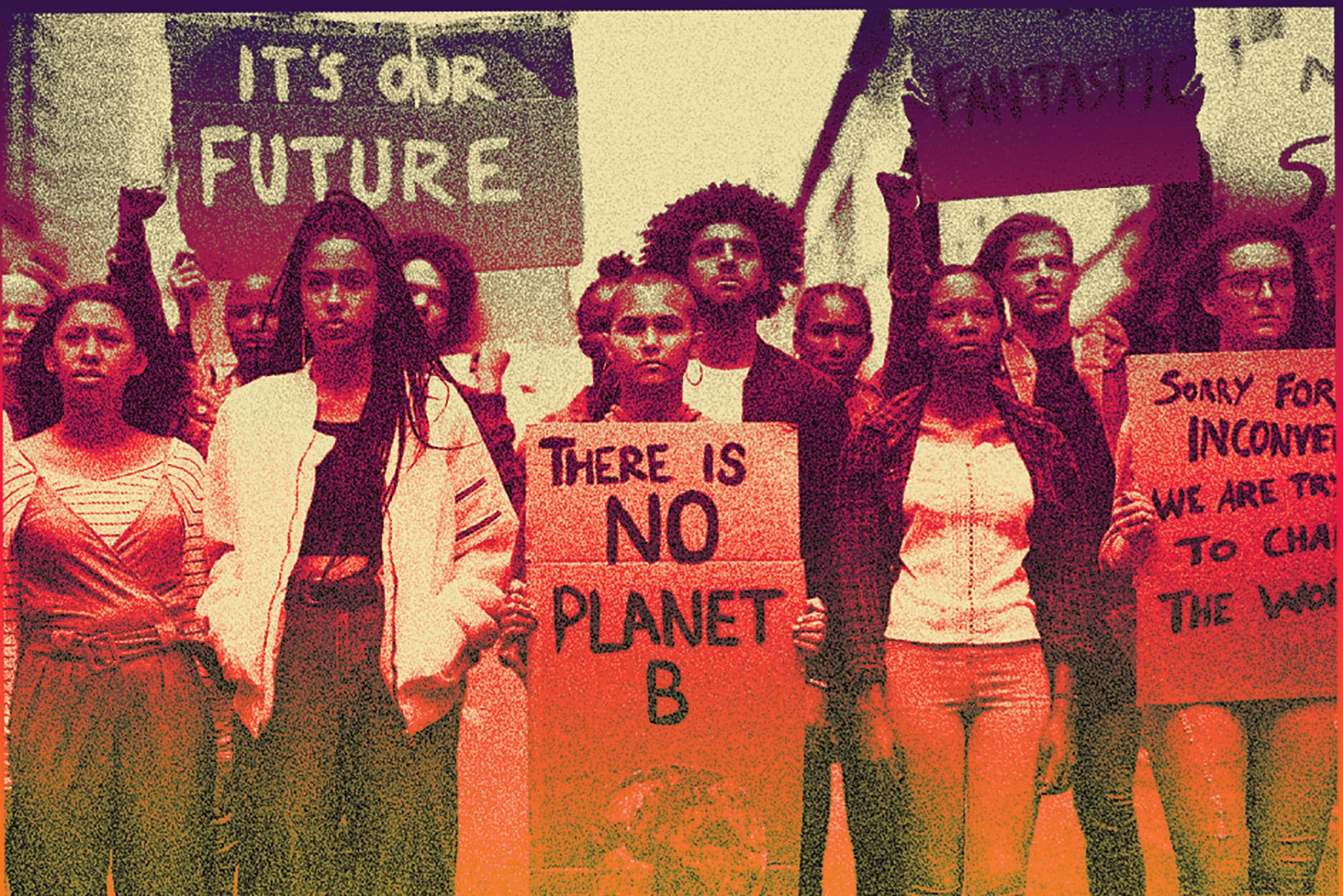
Kalven’s ideas resonated because, in his time, universities were more ideologically diverse than they are now. Back then you were as likely to meet a Marxist radical on campus as a Burkean Tory. In such a mixed environment, institutional neutrality protected everyone. Over the last two decades, however, political diversity on campus has declined substantially, perhaps because of larger social trends or hiring bias. Once an ideological faction gains power within a workplace, it entrenches that power via the interview-and-selection process.
Debate still happens, but within a narrower aperture of acceptable opinion. Numerous peer-reviewed studies from the United States show that, on campus, centrist and progressive professors vastly outnumber conservatives. Canadians don’t have a robust body of research on this subject, but some data suggests that our schools are similarly polarized. In such a lopsided environment, some academics will feel the need for institutional neutrality more urgently than others. In 2022, the polling firm Leger found that, among professors who vote Liberal, NDP or Green, 88 per cent felt no pressure to hide their partisan loyalties. Among professors who voted for the Conservatives or the People’s Party, 44 per cent said they feared being outed to their colleagues, and 57 per cent admitted to having self-censored.
The principle is easiest to maintain when everyone has a stake in it. So it’s hardly surprising that as schools became more politically homogeneous, neutrality also decayed. Today, university administrators freely take partisan stances. Over the last decade, seemingly every Canadian university has expressed its commitment to ameliorating climate change, ending colonialism and supporting Ukrainian independence. Because these were broadly consensus opinions, they didn’t engender much pushback. There were occasional free-speech crack-ups: in 2021, Jordan Peterson, the psychologist turned conservative commentator, resigned from his faculty position at the University of Toronto, protesting that he had become “academic persona non grata” because of his “unacceptable philosophical positions.” But these controversies were mostly confined to the fringes of the campus right. Having adopted an outspoken, socially engaged communication style, most universities still functioned relatively well. The centre appeared to be holding—right up until the fall of 2023.
On October 7, 2023, when Hamas terrorists went on a murderous rampage in southern Israel, they may not have sought to spark a culture war on the other side of the planet. But the public fallout reverberated across Canada.
As news of the attacks hit home, university administrators felt a need to respond. When you’ve repeatedly declared your commitment to Indigenous reconciliation and climate justice, you can’t remain silent about the mass murder of Jews. But they faced pressure to contextualize their responses. The attack, after all, had not occurred in a vacuum. For some people on campus, the events of October 7 had to be considered alongside the ongoing depredations of Israel—which they view as a settler-colonialist enterprise intent on subjugating Palestinians, who have been consigned to non-states or occupied territories. Most supporters of this viewpoint didn’t condone Hamas’s attack, but they saw it as one episode in a long-standing conflict that also implicated Israel.
For other people, the appropriate context was the global rise of murderous anti-Semitism: Hungarian Jews smeared by their government, French Jews slashed with machetes or thrown from balconies, American Jews gunned down at synagogues. The October 7 attacks, they pointed out, were part of a larger global pattern. To miss this connection was to miss everything.
Administrators had two options. They could focus on the Israeli-Palestinian conflict, or they could lean into discussions of resurgent anti-Semitism. Either would infuriate a segment of the campus community. If administrators downplayed Israel’s alleged complicity, they would be accused of ignoring—and therefore condoning—colonialism itself. If they played up Israel’s culpability, they’d be charged with invoking an ancient anti-Semitic trope: holding Jews responsible for violence perpetrated against them.
Taking a stance is easy when the consensus is obvious. But discussions of Israel-Palestine don’t lend themselves to tidy conclusions, and in the aftermath of the attacks, university administrators fumbled from one PR crisis to another. In 2024, researchers at Brandeis University, in Massachusetts, and the University of North Carolina studied 100 institutional statements about October 7 across the United States. They found that 49 of these universities retracted or amended their statements, sometimes with profuse apologies.
Canadian schools flip-flopped too. On October 16, 2023, Vivek Goel, president of the University of Waterloo, released a short missive condemning “the heinous terrorist attack by Hamas” and “the rapidly worsening humanitarian conditions in Gaza,” and affirming that the school “stands against all forms of hate.” It was a careful, guarded response, crafted to spark as little trouble as possible. It failed spectacularly.
For pro-Israel staff members and students, Goel’s message seemed offensively even-handed, like yelling “all lives matter” after the murder of George Floyd. Barely a week had passed since the worst slaughter of Jews in 80 years, but Goel seemed to generalize toward a tepid condemnation of “all forms of hate.” He didn’t outline specific measures to protect the campus Jewish community. “I feel ignored by UW President and administration,” wrote David Simakov, a Jewish engineering professor, on LinkedIn.
Other people criticized Goel not for an excess of even-handedness but for a lack of it. They noted that he’d condemned the October 7 assault as a “terrorist attack.” But he described the deadly—and, to their mind, genocidal—offensive in Gaza as a set of “humanitarian conditions,” as if the violence had emerged from nowhere. Goel had forthrightly named Hamas as the perpetrator on October 7, but who did he think was behind the retaliation? “Where this statement fails students and humans,” wrote student Yasseen Mobada in an op-ed for the school newspaper, “is where it fails to condemn Israel for intentionally manufacturing the aforementioned horrible humanitarian conditions in Gaza.”
In the months to come, Goel issued repeated amendments to his statement, creating a small corpus of assorted opinions—all in the university’s name. He didn’t win many allies. Pro-Israel organizations on campus continued to distrust him. Pro-Palestinian activists called him “Genocide Goel.” In October of 2024, Goel announced that, for personal and family reasons, he would not seek a second term as president.
Administrators also struggled with students’ responses to the crisis. In some cases, schools even breached their own protocols. In the fall of 2023, three York University student unions released a joint statement heralding the October 7 attacks as acts of “resistance” against “so-called Israel”; in response, the university threatened to strip the unions of formal recognition. But student-union leaders are democratically elected, and campus administrators normally refrain from questioning their legitimacy. Students can always vote them out, after all.
In May of 2024, the University of Manitoba denounced its own valedictorian, Gem Newman, after he used his commencement address to condemn what he called Israel’s “genocidal war.” Censoring valedictorians is also unusual, because honorary speakers are expected to speak their minds. And, in July of 2024, the University of Windsor negotiated a settlement with pro-Palestinian protestors who’d set up an encampment on campus. The protestors agreed to disperse, and the university agreed, among other things, to petition the federal government to support Palestinian statehood and a ceasefire in Gaza. This decision set an odd precedent, since the protestors were clearly violating regulations against occupying and limiting access to common space. Break the rules, Windsor seemed to say, and we’ll let you dictate university policy from your tents.
The most egregious debacle occurred at the Lincoln Alexander School, the law faculty at Toronto Metropolitan University, which was founded in 2017 in opposition to the idea of neutrality. The school promised prospective students a “progressive” legal education. Administrators wrote blog posts about how students should view the law as a tool for equity, social justice and anti-racism. Today, the school’s response to the aftermath of October 7 offers a national cautionary tale about institutional position-taking, which can back administrators into corners they can’t escape.
In the fall of 2023, 73 students signed an open letter calling for the administration to denounce Israel’s military operation in Gaza. The letter declared that Israel was not a country and expressed support for “all forms of Palestinian resistance.” To some Jewish students, this statement seemed to condone the violence of October 7. (Elsewhere, the letter refers to Hamas’s actions as “war crimes”; the document is contradictory and difficult to parse.)
Immediately, partners at high-profile law firms publicly pledged not to hire the signatories. On social media, they denounced the students as terrorist sympathizers, motivated by hate. None of these events directly implicated the Lincoln Alexander School. By signing their letter, the students were exercising their free-speech rights; by publicly denouncing the students, members of the legal community were exercising theirs. In theory, the administration might have responded by not responding at all. But having explicitly disavowed neutrality, the university couldn’t revert to it.
Administrators faced conflicting pressures. The president and the dean were inundated with emails from donors, staff and outside legal professionals. Some wanted the school to defend the students, who were facing a pile-on from their professional community. Others insisted the school censure the letter’s signatories. Ultimately, it did the latter, releasing a statement condemning “the sentiments of anti-Semitism” in the students’ petition. It also opened an investigation into the signatories, forcing them to continue their studies under threat of expulsion. (In the end, the students were not expelled.)
The fallout was dramatic. Hundreds of dissenting lawyers signed another open letter equating the atmosphere of denunciation with McCarthyism. (My sister, a criminal lawyer, signed this counter-letter.) The school tried to ease tensions by inviting students to listening circles. Attendance was sparse; after being impugned by their institution, many invitees feared further condemnation.
To investigate the affair, the school retained Michael MacDonald, a former chief justice of Nova Scotia, who released his report in May of 2024. MacDonald chastised the students who signed the original letter, in part for endorsing a document whose implications they didn’t fully understand. But he was even harsher on the school itself. Controversial or unpopular speech, MacDonald found, is not by definition hateful, and criticism of Israel is not by definition anti-Semitic. In denouncing the students, he said, the university had violated its own free-speech policies.
The Lincoln Alexander School wasn’t yet eight years old and, in a dizzyingly short time, it had gone from promising an enlightened approach to legal education to censoring its students to having the basis for its censorship discredited by an esteemed Canadian judge. For a law school, it was a terrible look. Some of the signatories to the original letter are now suing the school for defamation. They’re seeking $10 million in damages.
The aftermath of October 7 was bound to be messy, no matter what university administrators did or didn’t do. Institutional neutrality can’t shield schools from controversy. But it can ensure that administrators act with integrity. That means not responding to world events with a barrage of confusing statements. It means not censoring students, faculty members or honorary speakers. And it means enforcing rules even-handedly. Had they adhered to these standards, administrators might have come out of the crisis looking steadfast and principled, rather than craven and confused.
One of the upshots of this chaotic period is a renewed interest in neutrality, since university administrators can now clearly see what Kalven saw. In the last year, schools including Harvard, Waterloo, Simon Fraser and the University of Toronto, among others, have formally committed to institutional neutrality. They’ve pledged to critically review statements they’ve made in the past and develop guidelines toward a more restrained communications style.
As the political winds shift, proponents of neutrality—like Irvine and his fellow petitioners—clearly see an opportunity to push their agenda. In 2024, 13 professors at Simon Fraser took their faculty association to court after it passed a motion condemning “Israel’s destruction of the education system in the Gaza Strip.” The professors claimed that such statement-making lay outside of the association’s authority. (They lost their case; the court decided it lacked jurisdiction in university affairs.)
Proponents of neutrality are often accused of being motivated by personal grievances or politics, rather than lofty principles. “One can clearly get a sense that there might be ugly ideological motivations behind the lawsuit,” wrote Emmett Macfarlane, a political scientist at the University of Waterloo, about the UBC case on his Substack. But even if this is true, it doesn’t follow that the arguments are meritless. Most people, when making political claims, have personal or partisan motivations for doing so. That isn’t a reason to ignore what they say.
There have been few developments since Irvine and his colleagues filed their petition in April, as UBC’s response is still pending. Because their case is before the courts, the petitioners declined my request for an on-the-record interview. Instead, I spoke to their lawyer, Josh Dehaas, a civil libertarian who litigates free-speech cases for the Canadian Constitution Foundation, a non-profit that initiates and intervenes in high-profile constitutional cases.
Dehaas says that both the Musqueam and Syilx Nations plan to speak out in court against Irvine and the petitioners. He’s disappointed that the case is being interpreted as an attack on Indigenous people. “It’s about the need to protect academic freedom generally,” he says. In addition to criticism, he’s heard from many well-wishers. “A lot of professors are writing to me or the applicants, saying that they support the case,” he says, “but they can’t state this publicly at the schools where they work.” He expects a hearing will happen sometime in 2026.
In addition to interviewing Dehaas, I sent the petitioners fact-checking questions, which they answered. I read their legal submissions and reviewed their academic writing on issues like free speech and ideological pluralism. I came away with the impression that the petitioners were arguing their points in good faith. But their case is not watertight.
Jeffrey Sachs is a political scientist at Acadia University who studies intellectual freedom and has been closely following the UBC suit. He told me that, among the petitioners’ three arguments—about land acknowledgements, statements on Gaza and hiring calls that require applicants to support DEI—the last is likely the strongest. “The job postings at UBC are basically saying, ‘If you want to get this job, you have to subscribe to a certain political belief,’ ” says Sachs. For him, it’s hard to imagine a clearer violation of institutional neutrality.
The question of land acknowledgements is more complicated. Sachs disagrees that a land acknowledgement is an apolitical statement of fact, akin to saying that grass is green. A fact can be neutral, but the choice to invoke it at a specific time, and in a specific manner, can still be politically loaded. It is true that Charles III is King of the United Kingdom and the Commonwealth. But if university administrators started announcing this fact in a ceremonious fashion before campus events, most people on the left would view the gesture as reactionary—a performance of deference to the monarchy. Nevertheless, says Sachs, civil courts are preoccupied with questions of harm: a successful lawsuit must demonstrate not only that the respondent broke the rules but also that they did damage in the process. What specific harm, a judge may ask Irvine and his fellow petitioners, have land acknowledgements caused?
Sachs says that the petitioners’ final complaint—that some faculties and other campus entities had made statements expressing support for Palestine—is also less solid than it may appear. Had a university president or senior administrator made such a statement, the petitioners would have a better case. But all the infractions cited were issued by sub-administrative entities. Were these entities, or their leaders, really speaking for the institution, wonders Sachs? And if neutrality dictates that even academic departments cannot make political statements, then can a gender studies department speak out against gender-based violence? Can a Jewish studies department memorialize the Holocaust? Even judges sympathetic to institutional neutrality may wonder if the petitioners are working with an untenably expansive understanding of the concept.
Perhaps the biggest problem with the case is not the grievances themselves but the means of redress. As self-styled defenders of free speech, Irvine and his peers clearly see themselves as civil libertarians. Their goal is to rein in a campus bureaucracy that, in their view, has acquired too much power. But their suggested remedy—bringing in the courts to micromanage the affairs of an independent university—is a civil libertarian’s nightmare.
UBC will have little trouble coming up with viable arguments to defend itself. But if the specific lawsuit is questionable, the larger case for institutional neutrality—as a guiding principle, not a government-enforced edict—is stronger.
One argument that has been levelled against Irvine and the other petitioners is that institutional neutrality, as they argue for it, is just a Trojan horse for conservatism. This was the idea put to me by Liza Hughes, chair of the BC Civil Liberties Union. “There are so many things that we take for granted as neutral that really are just status quo,” she says. But this analysis misses a key point: if Irvine and his peers win their case, they will not have locked in a victory for the political right. They will have set a legal precedent whereby all people at UBC—lefties included—can sue the school for making political statements.
Of course, some people are drawn to neutrality for self-serving or ideological reasons. But as a norm, neutrality serves everyone. If schools had adhered to it during the McCarthy era, they would’ve supported socialist intellectuals in their midst. If they’d adhered to it in 2023 and 2024, the beneficiaries would’ve included students speaking out for Palestine. Recently, professors across Canada and the U.S. have been attacked for public statements that made them seem insufficiently saddened by the murder of Charlie Kirk. If any university wishes to embrace neutrality today, then protecting those faculty members—their job security and their right to speak their minds—will be the first order of business.
Another common argument against institutional neutrality is that universities are, by definition, political. “I am concerned that not speaking on contemporary world affairs is an abdication of leadership responsibilities,” wrote Peter Salovey, the president of Yale University until last year, in 2024. Universities are not just spaces of abstract contemplation, Salovey argues; they are engines of social progress. This sentiment has been echoed in numerous dissenting takes on the UBC case. But when a university president consults with their communications team to craft a hasty response to the headlines of the day, the move is unlikely to make the world a fairer place, especially if it chills academic freedom or contributes to growing distrust of the academy.
Change is mostly downstream from other work that academics do—open-minded research, painstaking data collection, rigorous debate and good-faith efforts to draw accurate conclusions untainted by bias. If university administrators value this work, they should probably get out of the way and let academics do it. Institutional neutrality, therefore, isn’t about renouncing social progress; it’s about protecting the intellectual conditions that make such progress possible. And while social justice is often a happy byproduct of academic research, it isn’t the only goal. Many academic breakthroughs—novel theories of consciousness, photographs of black holes, close readings of T.S. Eliot—are valuable, even if they don’t advance equity. In his court submissions, Irvine appended a letter that the university had sent him to commemorate his 35th anniversary at the school. “The work you do contributes to UBC’s ability to advance social justice/create solutions for climate change and a healthy planet,” the letter read. Irvine was mystified. “I view the letter as … an expression of indifference to my 35 years of academic research, teaching and publication in the areas of formal and informal logic, epistemology, analytic philosophy and intellectual history,” he wrote in his court submissions. He added that his research interests “in no way concern the advancement of ‘social justice’ and do not, in purpose or effect, deal with climate change or a healthy planet.” Clearly, the university misunderstands Irvine’s work. Perhaps it also misunderstands itself.
This story appears in the December 2025 issue of Maclean’s. You can buy the issue here, subscribe to the magazine here or send a gift subscription here.
Get the Best of Maclean’s straight to your inbox.
Sign up for news, commentary, analysis and promotions. Join 80,000+ Canadian readers.