
How York students are putting AI and VR to work on the world’s biggest challenges

The instruction sounds counterintuitive: take the problem you’re trying to solve, climate change, food insecurity, a flailing organization, and ask the AI to make it worse.
That’s exactly the kind of move students are learning to make in Innovation and Creativity, an undergraduate course in York University’s Faculty of Liberal Arts & Professional Studies (LA&PS),, taught at the school’s new Markham campus. Inverting a problem, surfacing the assumptions you’d have to abandon, asking the model to push back instead of agree — these are the warm-up exercises in a classroom where large language models are treated less like search engines and more like thinking partners.
"New students tend to use large language models as confirmation tools," says Dr. Anoosheh Rostamkalaei, assistant professor of entrepreneurship and innovation. "We guide them to use these tools differently, as sounding boards that draw on ideas from many fields to help connect disciplines." By experimenting with prompts, deliberately seeking out counter-arguments and even asking AI how a problem could be made worse, students learn that the most useful answers usually come from better questions.
That instinct, to interrogate before you accept, runs through the whole course. Offered through the School of Administrative Studies, Innovation and Creativity sits at the intersection of liberal arts thinking and hands-on, technology-driven learning. It’s also where students start to think like entrepreneurs in the broadest sense of the word: not only as founders of new ventures, but as people who can spot opportunity, mobilize resources and build something where there was nothing, inside an organization, across a community, or out in the open market.
Stepping into the problem
Critical thinking is one half of the equation. Immersion is the other.
In the same course, students slip on virtual reality headsets to walk through environments and conversations that would be impossible, or impossibly expensive, to stage in a traditional classroom. They might simulate a difficult leadership conversation, explore an unfamiliar community before designing a service for it, or pressure-test a business model under conditions a slide deck could never replicate. VR turns abstractions into something they can stand inside, prod at, and revise.
This hands-on work is made possible through collaboration with York University Libraries’ Multimedia Creation & Design Lab, where students and faculty access the specialized equipment, spaces, and technical support that bring these immersive experiences to life.
"Much has been made of how AI has the potential to replace jobs, and students are more aware of this fact than anyone," says Dr. Andrew Sarta, assistant professor of strategy at the School of Administrative Studies. "We try to chart a different path, by demonstrating how students can augment their skills with AI." Combining VR simulations with AI-driven analysis, students iterate faster, test more hypotheses and refine their thinking before they ever take an idea into the real world. Crucially, they also learn that the human at the centre of it, the one with curiosity, judgment and a point of view, is still what makes any of it useful.
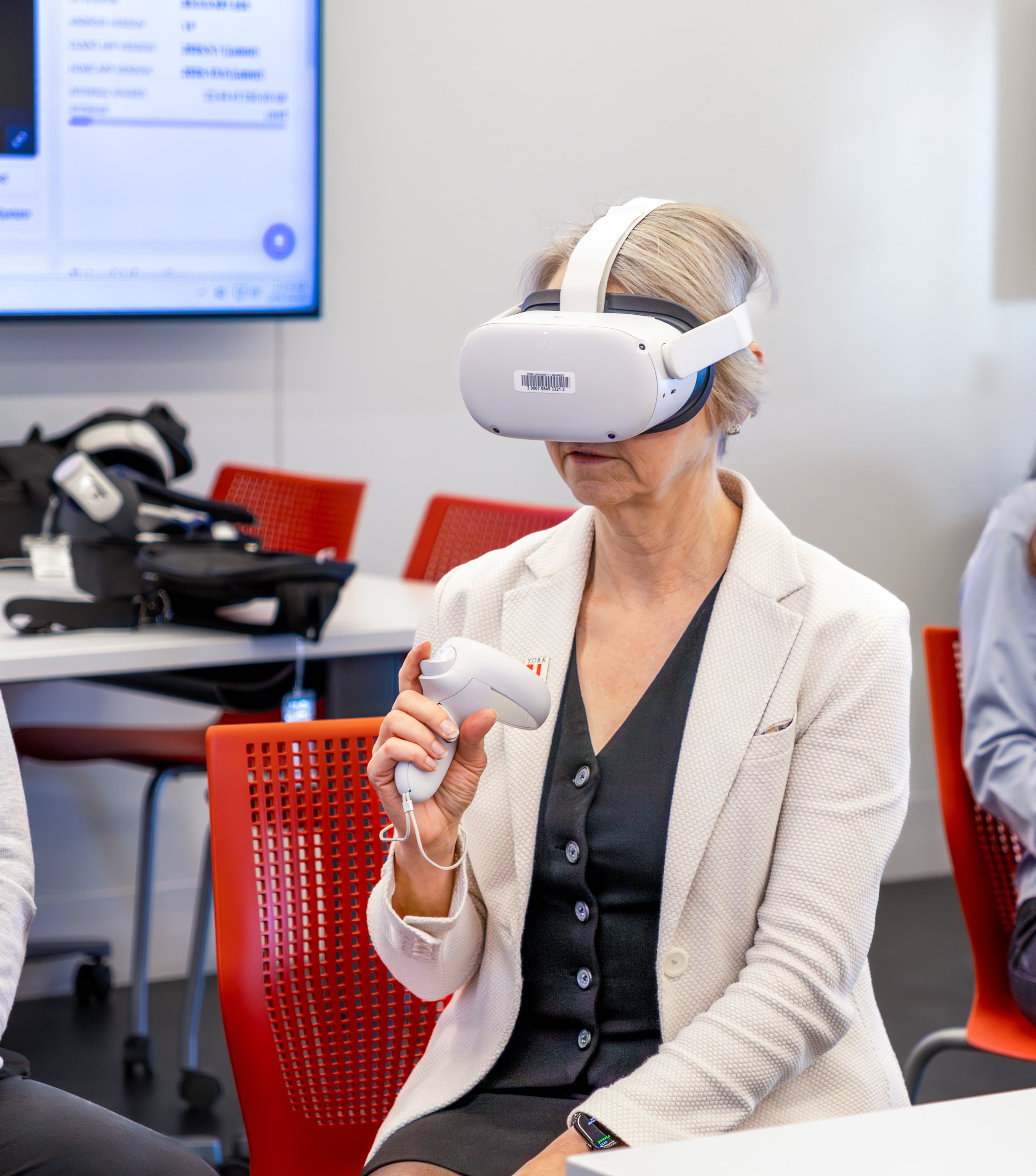
During a recent visit to the Markham campus, York University president and vice-chancellor Lisa Philipps tried out the course’s VR AI chat feature firsthand. The experience reflected her broader vision for how the university is approaching this technology. "AI literacy is becoming foundational to every field of study, and York is committed to ensuring our students graduate with the skills and the critical judgment to use these tools responsibly and effectively," says Philipps. "What we’re building here goes beyond any single course. It’s about preparing students to lead in a world where human insight and technological capability need to work together."
For Ayush Mitra, who took the course, that connection between human judgment and technology is the part that stuck. "This course pushed me to think beyond textbook answers," he says. "It helped me understand how innovation actually happens, when you challenge assumptions and rethink the problem itself."
Entrepreneurship, in every form it takes
The students leaving Innovation and Creativity aren’t all going to start companies, and that’s the point. Some will. Others will launch social ventures, prototype new programs inside large organizations, or carry an entrepreneurial instinct into the public or non-profit sectors. What unites them is a way of thinking, equal parts liberal arts curiosity and applied entrepreneurial discipline, that employers are loudly asking for.
LA&PS, one of Canada’s largest and most diverse faculties, was built for this moment. With more than 100 programs that combine the liberal arts with professional and applied studies, plus deep investment in experiential and work-integrated learning, students graduate with both a foundation and a toolkit, equipped not just for a first job, but for a career that will keep changing shape around them.
By teaching students to use AI and VR with judgment rather than awe, York is reinforcing what a liberal arts education has always been good for: navigating complexity, thinking critically, and turning ideas into something the world can actually use.
Visit yorku.ca to learn more about the university and explore the Entrepreneurship and Innovation program offered through the Faculty of Liberal Arts and Professional Studies.