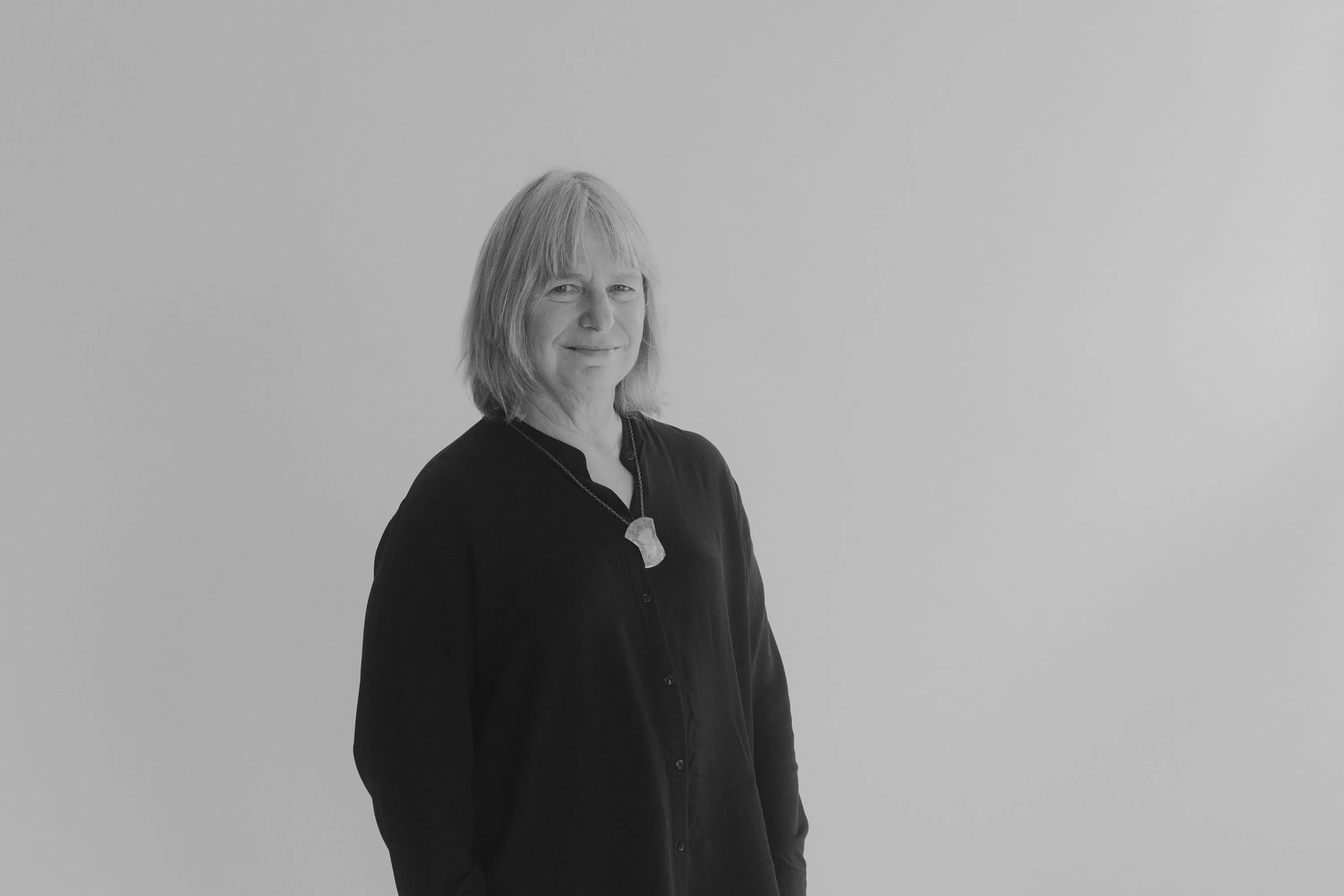
Suzanne Simard Speaks for the Trees
In the late ’90s, Suzanne Simard started what can only be (indelicately) described as a firestorm in the forestry world. Her Ph.D. findings, published in the renowned journal Nature, argued that trees weren’t the valiant loners scientists once believed them to be. Rather, they survived through symbiosis, communicating and even sharing carbon through a subterranean series of mycorrhizal networks (fungal root systems). Initially, Simard’s peers weren’t nearly as generous as the tree community—one reviewer rebuked her paper as “a dog’s breakfast”—but, over time, some listened more closely.
Related: Diana Beresford-Kroeger Is a Green Machine
Today, Simard isn’t just the tree world’s tallest poppy; she’s a global, Goodall-esque conservation icon. Her 2016 TED Talk is nearing the six-million-view mark. She’s been name-checked on Ted Lasso and provided inspiration for both Avatar and The Overstory, Richard Powers’s Pulitzer-winning novel. When she isn’t touring her own books (like this spring’s bestseller, When the Forest Breathes), Simard can be found where she started: in the woods, at work on the Mother Tree Project, a research initiative spanning nine B.C. forests. The difference is that, these days, she’s supported by a team of 20.
Your early research blew apart the scientific community’s long-held understanding of how forests work. It declared that trees weren’t competitive solo artists—they exchange nutrients with each other to keep ecosystems going. You’re also the reason we have the term “wood wide web.”
An editor at Nature was responsible for that. They put that phrase on the cover after I published the first part of my doctoral thesis. The world wide web emerged in the early ’90s, and that paper came out in 1997. So it just stuck.
The most triggering aspect of your findings seemed to be that they challenged the Darwinian notion that to be selfish is to survive. I’m sure there’s a super-helpful takeaway in there for present-day humanity, but what?
So much about our societies is shaped around the idea that we’re all just competitors—our food-production systems, our natural-resource industries, our economies. But we’re not! Even Darwin understood that co-operative and competitive relationships created fitness. Lynn Margulis, an American evolutionary biologist, theorized that some of the organelles in human cells evolved from other, foreign organisms. She took a lot of heat for that. And, when we sequenced the human genome in the ’90s, we found all this genetic material from viruses and bacteria. We are a species made of many species.
I love that you use the word “creatures” when you talk about trees. It implies, to me at least, that they have weird little inner lives just like us. Jane Goodall caught a lot of flak for naming her merry band of chimps in Tanzania. Have you named any of your guys?
I haven’t—not like Jane Goodall named Greybeard. More often, I call them grandfather trees, mother trees and so on. I’m trying to convey that some trees are the regenerative centres of forests: they give certain seedlings a head start and can even recognize their own offspring. Calling what I was doing anthropomorphizing, as some of my critics did, was just another way to dismiss my work.
You’ve spoken about how that widespread, persistent rejection from your peers affected you—for a while, you were even keeping your camera off during video calls. How did you bounce back?
It was hard and it took a long time. Some people even filed complaints with my university saying I lacked scientific integrity. I had a counsellor who helped me immensely.
And you absconded to the woods, right? That always helps.
During that period, I also lost my mother, a good friend and a grad student in quick succession. I was so demoralized that I headed to the Amazon. That was pivotal in my healing. I talked to shamans—people who understood that spiritual connection to the trees.
Did you do ayahuasca while you were there?
I don’t want this to cement that I’m a “woo-woo,” but I did do ayahuasca in ceremony. I went in with the intention of asking the forest whether I should continue my research, because I’d been hit so hard. When I was on my journey, a message came back loud and clear: You need to keep doing your work. I had to help protect and restore the forest. All of our lives depend on it.
After providing us with a better idea of how forests function, you moved on to analyzing how we tend to them. How far from the ideal is Canada’s current management style?
I can speak for B.C., where I live and work. The vast majority of the harvesting we do is clear-cutting “with reserves,” which basically means leaving just a few trees behind. We can thin out the forest to reduce fuel loads and open up the understory for plants and wildlife. But taking all the trees—especially the biggest ones, which are the most valuable in the lumber marketplace—isn’t a good approach. Since 1990, Canada’s forests have been shifting from carbon sinks to carbon sources because of wildfires and climatic stress, but also because of how we’re logging. Forests are decomposing faster than they can photosynthesize and return that carbon to our ecosystems. Canada’s not unique in this way, either; scientists suspect this is happening in most of the world’s major forests.
Cool. And now we’re dumping money into carbon-capture projects to deal with a problem trees and beetles used to handle on their own. Makes sense.
Exactly. This is part of the reason why Canada is now just behind Saudi Arabia—a petrostate—in per-capita emissions. We’ve got to get a grip on this.
Canada’s in the process of becoming more self-reliant, which necessarily means more extraction of our own resources. When you see all these new nation-building initiatives, are you thinking, What’s this going to mean for the trees?
Mark Carney’s self-reliance mission… I don’t disagree with it. But we have to be extremely careful. Forestry cuts were already unsustainable, and now we’re trying to cut even more to feed this self-reliant economy. We need healthy markets, but we also need to create markets that will value healthy forests. One avenue is B.C.’s output-based carbon-pricing system, enacted in 2024, which requires industrial emitters to pay for excess output. After the rules went into effect, the Cheakamus Community Forest near Whistler experienced a revenue surge of 600 per cent from carbon-credit sales alone.
I suspect there are some people who look at you and think your work is all peace, love and greenery. But it also involves getting escorted off a protest site at Fairy Creek and being chased by grizzly bears. To what extent are you engaging with the terror of the natural world as much as the beauty of it?
It can be terrifying, it’s true. When you’re working in the bush, as I’ve done my whole life, you’ve got to be quick on your feet. Anything can happen: a road might wash out, for example. Your truck might not start, which is a matter of life and death if you’re 80 kilometres out in the backwoods. I’ve fallen and slit open my arm. I’ve also had many experiments burn down in the last 10 years. I lose them to wind storms and beetle outbreaks too. It’s hard to see your research literally go up in smoke, but then I try to use that as a stepping stone to better understand fires. It’s dangerous work—a devotion. Definitely not an office job.
After Artemis II’s successful lunar trip earlier this year, some people expect to see an uptick in astronaut costumes this coming Halloween. For all the brainrot celebrity worship, there’s still a sense that scientists are big-time heroes. As a self-identified shy person, has it been hard to come to terms with your fame?
It can get overwhelming; I can’t offer all the solutions. I see myself as more of a translator than a hero. Not everyone gets to see what I see.
Did you see a bump in your class attendance at UBC once the world caught wind of you? “We’re here because we heard about you on Ted Lasso!”—any of that?
A lot of students said they came to UBC—and UBC Forestry—because of me. I just taught a class with 1,800 students. It was online, so it was easier for them to come, but that was a bit of a testimony. I’ve had people tell me they read my books in their creative-writing and ecology courses. That’s really cool. So, yes, fame has changed everything.
You were the inspiration for dendrologist Patricia Westerford in Richard Powers’s book The Overstory. Did you read it?
Oh, yeah. I thought it was lovely. A devoted scientist who had something groundbreaking to say, who got pushback? I’m glad that story was told.
Was there anything Powers didn’t get quite right?
Well, at the end of the book, Westerford considers drinking a potion containing poisonous fungal spores while delivering a speech to a crowd. I’m not that person.
There’s a lot of hope in your own writing, but also a lot of grief. Non-foresters immerse themselves in nature to process life’s trials, but you’re in it all the time. Did it help you in your hardest moments?
My comfort place is the forest. If I go to the city, I have the opposite experience; I’m stressed out. If I can’t go to the woods physically, I’ll go there in my mind.
I don’t want to risk sending a stampede of readers out there, but can you be more specific about where these comfort places are—for example, on a map?
At my home in Nelson, B.C., I have mountains all around me. I love hiking in Kootenay National Park—any of the peaks around Kaslo, anywhere in the Selkirk, Purcell and Valhalla ranges. I don’t know how many names you want.
As many as you’ll give me.
I love the Pacific Coast as well—the Inside Passage. If you ever get out to the Great Bear Rainforest, it’s incredible. Haida Gwaii is absolutely stunning. And, earlier in my life, I spent a lot of time out in the Wells Gray Park area.
I was surprised to learn that you come from a line of loggers. What an incredible generational arc, to go from that to a world-famous conservationist.
To me, it totally fits. My great-grandfather and my grandfather came to the interior from Trois-Rivières, Quebec, where they worked as selective loggers on horseback. They weren’t clear-cutting; for the most part, they’d only take out the cedar poles. When I was growing up, the forest always looked healthy and abundant. Later, when I worked as a forester with a lumber company in Lillooet, that was a completely different thing. My ancestors were craftsmen; logging corporations are not.
It sounds like you absorbed a lot in the bush. I understand you also ate a lot of dirt.
As a kid, that was my favourite thing. I don’t know why.
Did you have some kind of undiagnosed nutrient deficiency? Did it taste good?
I didn’t eat just any dirt; I’d figure out what kind tasted the best. In my world, that was the stuff near the birch trees that surrounded my family’s houseboat. I ate it less and less after I turned 10, because it wasn’t really, you know, “cool” to do.
You’re wrapping up a months-long book tour this summer. Let me guess where you’re headed with all that free time…
I’ve been on the road since the beginning of March, so yeah, I’m tired. I have a sabbatical coming up, which means I don’t have to teach this year. I’m just starting to write another book, In The Realm of Giants, with my agent, Doug Abrams. He grew up in an apartment in New York City, with no connection to the natural world. So it follows our respective journeys—him to see the forest and my soul-searching. Of course, I’m going to spend as much time outside as I possibly can.
What is the most indoorsy thing you do?
I’m learning to play the accordion. I just started in December, so I’m no expert.
How did you pick that up?
I was feeling a bit low, and I remembered how much I loved the Acadian music I’d heard when I was young. I think it filtered through my DNA somehow. One day, I went to the local music shop in Nelson, which is very tiny—almost like walking into a closet. I asked the girl working there if she had an accordion, and she said, “No,” then, “Wait a minute!” There was a student model in an old case in their back room.
What’s your “Hot Cross Buns?”
“La Vie en Rose,” over and over.
Let’s end on a similarly hopeful note. It’s always “old-growth forests are dwindling” and “fisheries are collapsing” and “mass extinction”—all of which is true. But the giant panda and the green sea turtle were just removed from the endangered species list. And, thanks in part to our curbed hairspray use, the ozone layer is re-forming over the Arctic. Environmental recovery is a reality—what a revolutionary thought!
I absolutely believe we can recover from the damage we’ve done to Canada. Ecosystems are wired to heal. When we leave some trees behind, pretty soon, there are thousands of seedlings, reaching over your head, full of life. Two years ago, while doing some work on the Mother Tree project, my students and I measured losses in all nine of our research forests due to clear-cutting. I’m talking thousands and thousands of data points. Half of that forest’s stocks have since recovered. I thought it would take 10,000 years.
See any connection with your own life there?
Of course. We’ve all evolved from the same root. If the trees can recover, so can we.
This interview has been edited for length and clarity.
What did you think of this story? Send a comment for publication to letters@macleans.ca, and supply your name and address. Comments should be fewer than 200 words, and may be edited for length and clarity.
Get the Best of Maclean’s straight to your inbox.
Sign up for news, commentary, analysis and promotions. Join 80,000+ Canadian readers.