Plucked from peril
Courtesy of Rupert Maundrell
The Makena set out for Halifax in fine weather under the steady hand of a respected skipper. It would be the yacht’s last voyage—and only the heroics of Canadian rescuers would spare its crew from tragedy.
Published: December 19, 2019
Plucked from peril
By Nick Taylor-Vaisey
On a serene day last spring in the North Atlantic, a cruise ship named Le Boreal was steaming towards a stop in the Azores when it encountered a lonely vessel, floating aimlessly with no crew, no mast and no apparent destination. Le Boreal’s crew must have stared down in confusion as the boat—a sailing yacht—drifted past; quickly, they snapped some photos they would later send along when they alerted Portuguese authorities. Though of seagoing calibre, this boat looked tiny next to theirs, and so battered by the North Atlantic elements that its mere ability to float seemed a minor miracle.
Soon after, Rupert Maundrell would see those photos. The British skipper-for-hire, a sailor who delivers boats for a living, marvelled at the images, which had been sent by maritime rescue officials in the Azores and passed through several hands before reaching him. Somehow, he thought, she had come through. And he shuddered at the memories the sight of the boat triggered.
Now, months later, Maundrell was back at work yet struggling with cruel recollections from that battle with the wind and waves. In these pictures, he could see emblazoned on the side of the hull proof that this once-beautiful craft had avoided the fate he feared it suffered. Its name was the Makena, and it was the only boat he’d ever lost.
What hell, the crew of the superyacht surely wondered, had it come through? What had become of the people who’d sailed it?
A few months earlier, Maundrell had survived a high-seas thrashing on this yacht that had knocked out the vessel’s steering and tore its rigging to shreds, putting him and his crew of three in the gravest peril he’d faced in 25 years at sea. That day, Maundrell and his team had been plucked from the ferocious North Atlantic by Canadian sailors and airmen in a high-stakes rescue that had made fleeting headlines and won plaudits for the daring rescuers—though few at the time knew the full extent of their heroism.
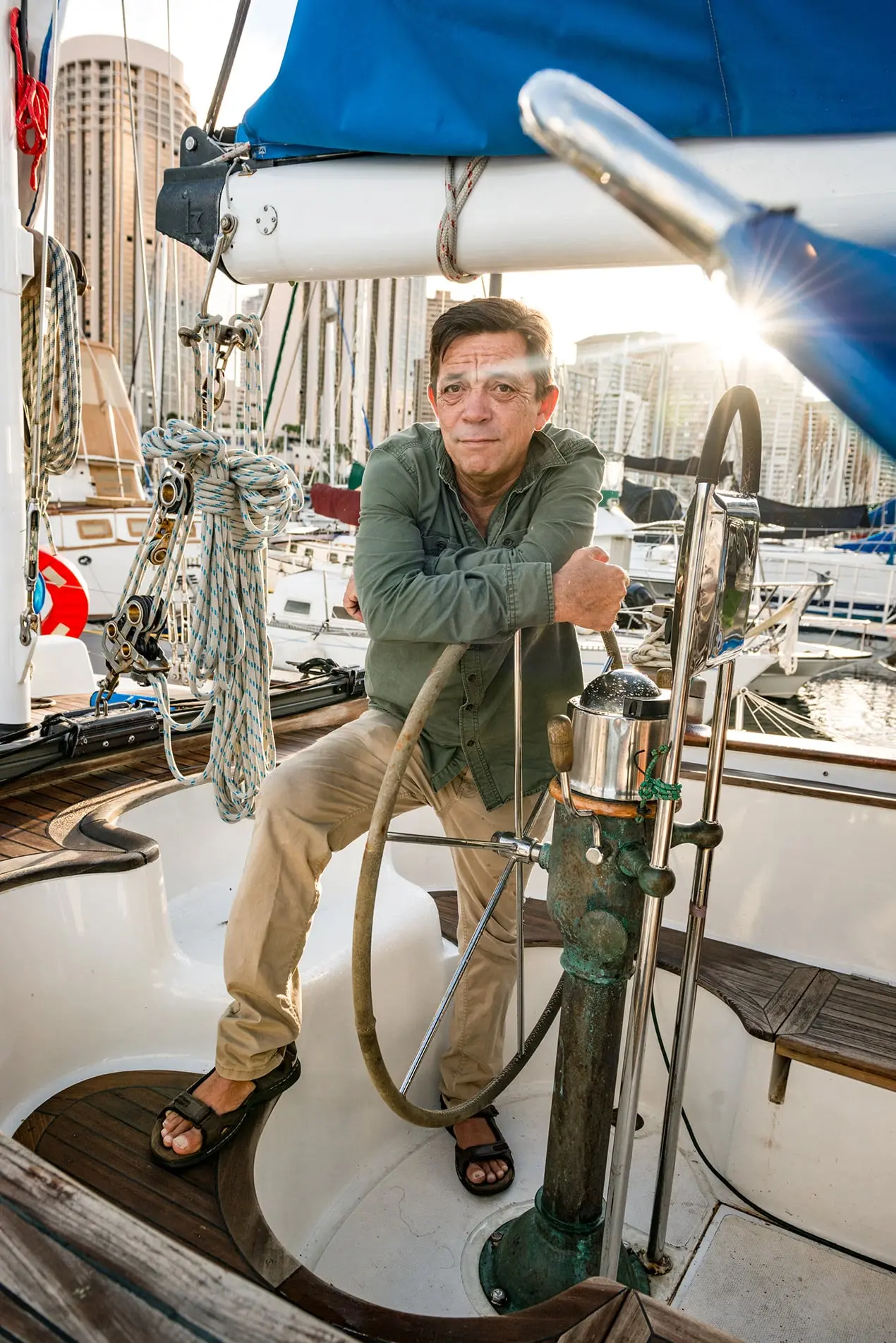
Maundrell aboard the Pacific Pearl in Honolulu. (Photograph by Jenny Sathngam)
Maundrell took the job. He found two crew, Eduardo Gomez Sanchez and Luke Ashworth, and a cook, Lisa Marie Kurtze. They met at the marina in Lefkas, on the western tip of Greece, where they boarded the Makena. Lefkas hit a high of 27° C when they departed on Oct. 13, bound for Nova Scotia. The wind and seas were calm.
Hagen made the purchase. He didn’t disclose the price, but Hanse 495s can go for about $250,000. Sturgeon found Maundrell. The skipper pegged the delivery cost at $200 a day. The broker agreed, and they had a deal.
But the crew didn’t get far before the first sign that this delivery wouldn’t be like all the others. The “autohelm,” a self-steering mechanism equipped with a compass and a motor that adjusts course and allows the crew to look after other onboard tasks, malfunctioned on the way to Gibraltar. That forced Maundrell to dock in Messina, Italy, where he made necessary repairs.
Hagen recounts the Makena “behaving beautifully” the rest of the way to Gibraltar. But the remnants of Hurricane Oscar, which was tormenting the seas to the west and north, held them up there. They left for the Azores on Nov. 2, where further weather delays held the Makena at port until Nov. 17. When they finally set sail for Nova Scotia, the plan was to follow a southerly route to avoid active weather systems. At that time of year, storms whip up with little notice.
The next 24 hours were, Maundrell writes, a “very noisy and somewhat violent experience.” The winds hit 76 knots—about 140 km per hour—and the boat was “heeling rather alarmingly” amid the fierce gusts (heeling is the nautical term for a sailboat’s sideways tilt). Kurtze, the cook, tucked herself tightly between a bunk and the bulkhead in the forward cabin, cushioning herself with a sleeping bag and trying to read a book as the boat endured a full day’s assault. Maundrell, who had positioned the Makena in such a way that it rode the waves as smoothly as possible, did not at this point figure his crew was “in any particular danger.” When the storm finally subsided, there was only one major problem: the steering was shot. They were adrift—at least temporarily.
Maundrell’s reputation as a delivery skipper and jack of all trades was rock solid. At an industry event in Texas, Sturgeon later told a group of colleagues from Florida about the voyage he’d brokered. “Everybody was saying, what is a pleasure craft doing in the North Atlantic in December?” he recalls. “When I mentioned Rupert’s name, a couple of the guys said, ‘Holy s—t, if it’s Rupert, they’re going to make it.’ ”
On Dec. 16, a Sunday, Maundrell sent a text message to Hagen that they were low on fuel but trying again to beat strong winds to Halifax. The next day, Hagen got a call from Sturgeon. There was a rescue happening off the coast of Nova Scotia. Could it be the Makena? Hagen told himself it was a different vessel. But a second phone call confirmed his worst misgivings. Hagen’s new boat had once again found trouble.
Maundrell had been delivering yachts since the mid-1990s, and was reliable enough in his business that he hadn’t advertised for a decade. Work always seemed to find him, and word of mouth is how Pat Sturgeon came across Maundrell in the summer of 2018. Sturgeon, a broker in Mississauga, Ont., had a boat named the Makena sitting in a Mediterranean marina that he’d matched with a buyer in Toronto. It was up to Maundrell to get the Hanse 495, a 49-footer sitting up on stilts, across the Atlantic.
The voyage was supposed to last 39 days. The crew would stop in Gibraltar, on the other end of the Mediterranean, and then set off for the Azores, the first leg of the Atlantic crossing. “Makena was an exceptionally well maintained vessel,” Maundrell later wrote in his own post-mortem report. “She was in beautiful condition and all systems on the boat had been very well installed and all worked without mishap.”
Oscar was the final named storm of the Atlantic hurricane season. Fifteen of them, starting with Tropical Storm Alberto on May 25, developed over warm Atlantic waters before the end of October. But not all storms have names, and they needn’t develop cyclones to generate hurricane-force winds. Out in the middle of the ocean, low-pressure systems can generate hurricane-force winds that produce gargantuan swells and screaming winds, and those were the conditions the Makena eventually encountered. On Dec. 8, forecasts indicated a major storm developing not far from the boat’s path. Maundrell prepared for heavy weather, and chugged north under the power of the boat’s small diesel engine to try to beat the worst of it. By the morning of Dec. 13, it was clear the most recent forecast, which he’d received on a satellite phone on a four-hour delay, was wrong.
When it was safe to inspect the boat, Maundrell discovered broken steering cables, the autohelm “snapped clean” from the steering assembly and the rudder jammed under the hull of the boat. Maundrell managed to fix the rudder even as waves still lashed the Makena, and then set about repairs to the steering mechanism. That required an unorthodox approach. “I completely removed the steering quadrant and put it back on upside down and 180 degrees around the other way from its original position,” he later wrote. That maneouvre allowed him to re-attach the autohelm using wires, wrenches and shackles he had at his disposal. After a couple of hours, to the relief of the crew, the Makena was under way.
The Makena’s destination for the winter was Halifax; it was too late in the year to sail down the St. Lawrence River to Toronto. That’s where John Hagen, a bariatric surgeon nearing the end of his career as chief of surgery at Humber River Hospital, was planning to live the retirement of his dreams. Hagen had sailed Lake Ontario for decades, often racing boats in the summer. (He and a fellow sailor were once the only boat to finish a particularly choppy three-day race around the lake.) Now, he and his wife planned to sail the Makena to the Caribbean, where they could go “off the grid” for months at a time. Sturgeon pointed them in the right direction: the Makena. “She had everything that you would need to live comfortably at anchor for months at a time,” Hagen, who closely monitored the vessel’s journey from Toronto and later chronicled the trip, wrote of the yacht. “There were freezers, fridges, hot and cold running water for showers, washing machine, solar panels, generator, and the list goes on.”
Back in Toronto, Hagen felt helpless. “I had no idea how I could possibly assist him while he was in the middle of the North Atlantic and I lay awake in my cozy bed worried that I might never hear from him again,” he wrote. But on the Makena, Maundrell’s crew were confident. “Lisa sent me a text back saying not to worry,” writes Hagen. “Rupert was working on a solution and she had no doubt he was going to come through.”
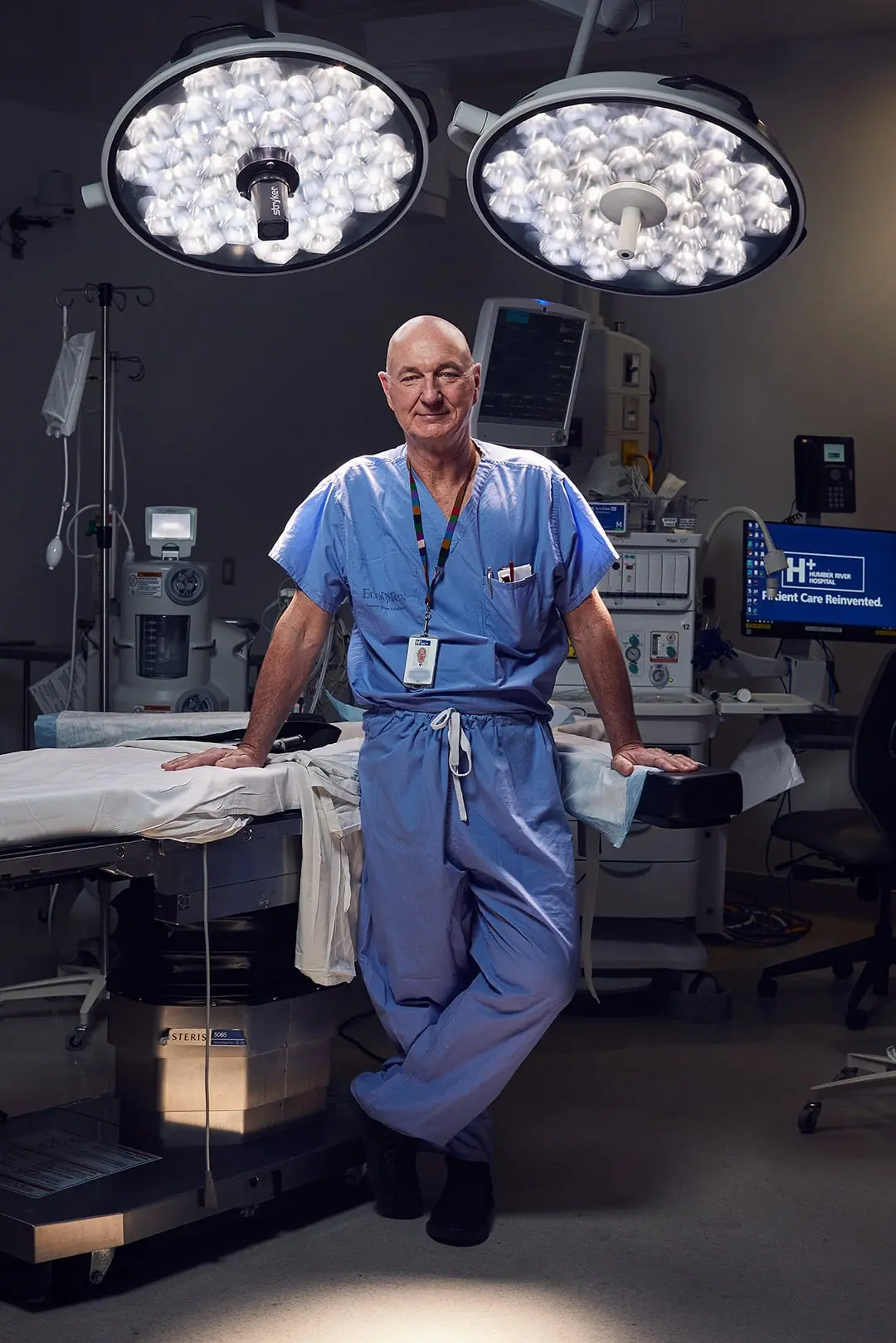
Hagen in an operating room at Humber River Hospital. (Photograph by Jaime Hogge)
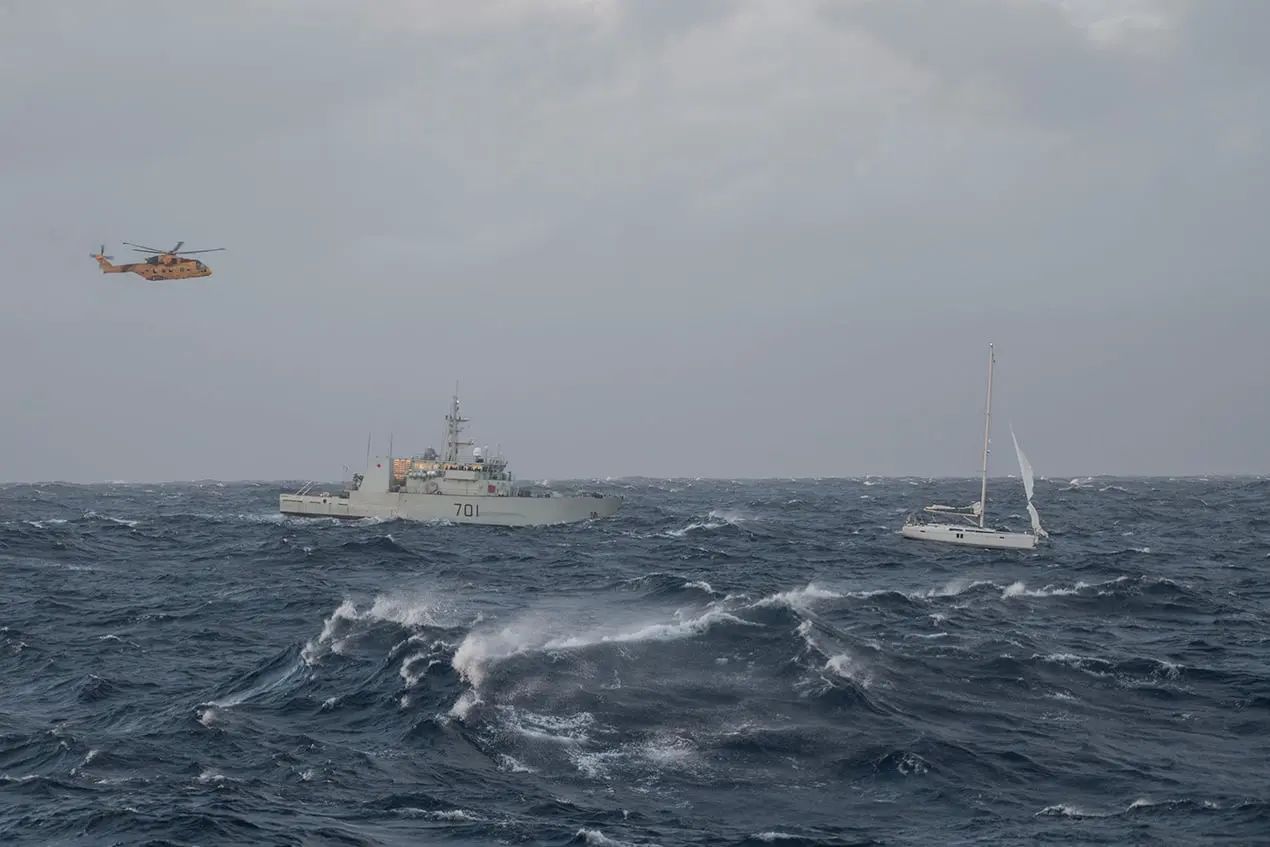
HMCS Glace Bay and the Cormorant helicopter during the rescue. (Aviator Braden Trudeau/DND)
The Cormorant was bound about 240 nautical miles offshore—almost 450 km. Covering that distance and working in rough conditions would push their fuel capacity beyond the limit, the crew knew—especially with all six of them and four expected passengers on board. Their only option was to refuel again en route at the Thebaud natural gas rig near Sable Island. Snow started, visibility shrank and winds picked up. After a turbulent flight, it was Sgt. Pete Lebel’s job to refuel the aircraft. Lebel, one of the flight engineers, stepped onto the Thebaud platform, looking around at the low clouds and high seas. “I was hit by an intense wind gust almost knocking me to the ground,” he later wrote in a report on the mission. “I had to lean against the aircraft to prevent the wind from pushing me around.” But the Cormorant couldn’t offer much support—it too was shaken by violent gusts.
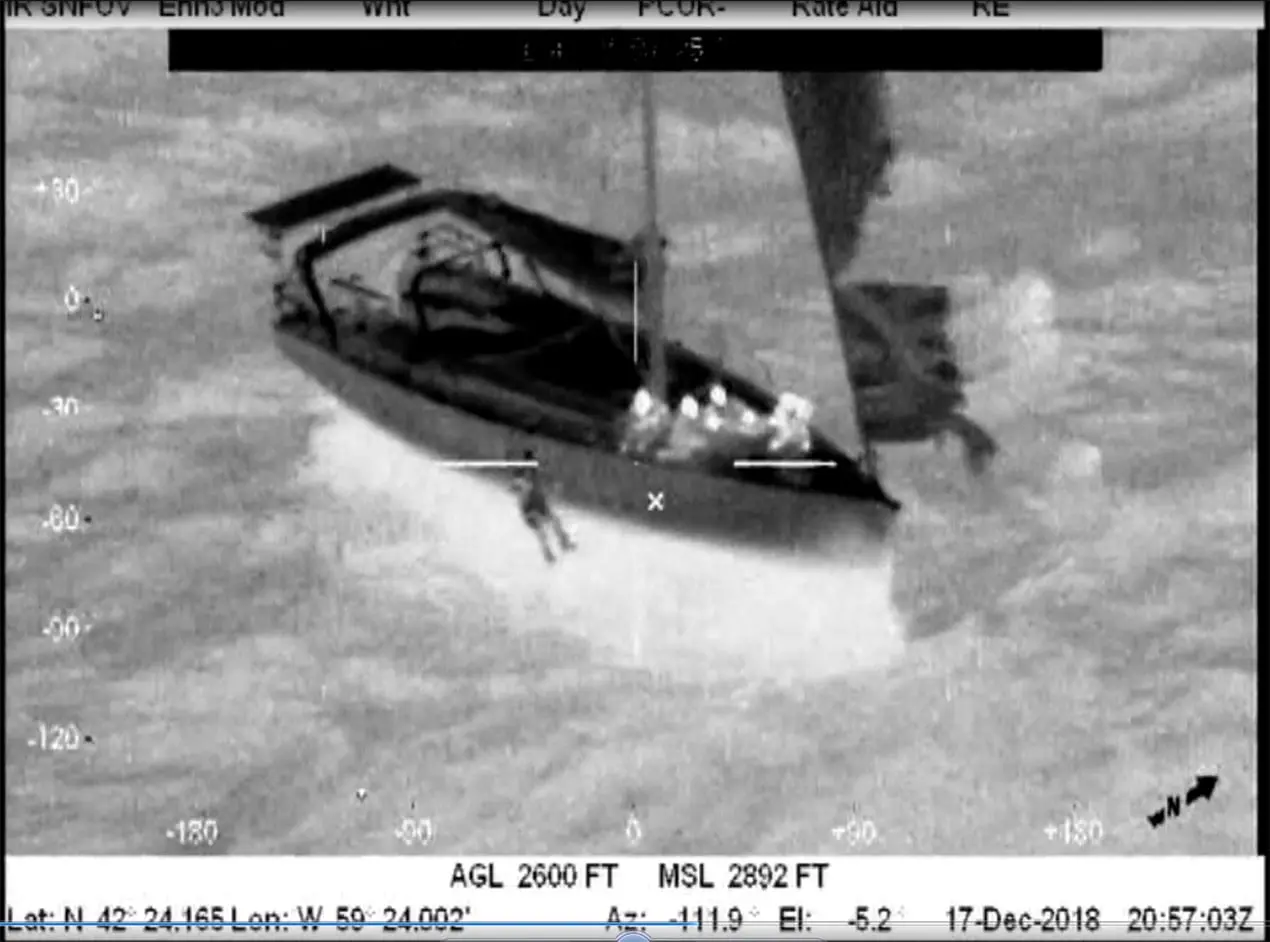
The Makena, as seen from a United States Coast Guard HC-144 that circled above the scene. (Courtesy of the Canadian Armed Forces)
It became clear almost immediately that nothing in this rescue would come easy. They struggled to land Nisbet on the small foredeck as he swung in the wind and the boat’s mast flailed wildly. “The helicopter was rock solid,” says Nisbet, “but there’s nothing underneath that’s staying still.” Eventually he touched down and, after a brief conversation with Maundrell, determined the order in which they’d remove the Makena’s crew. The cook was first, followed by the two sailors and then, finally, the skipper. Maundrell recalls a moment of levity with Nisbet, who joked the Makena was “probably the nicest sailboat I’ve ever been on.”
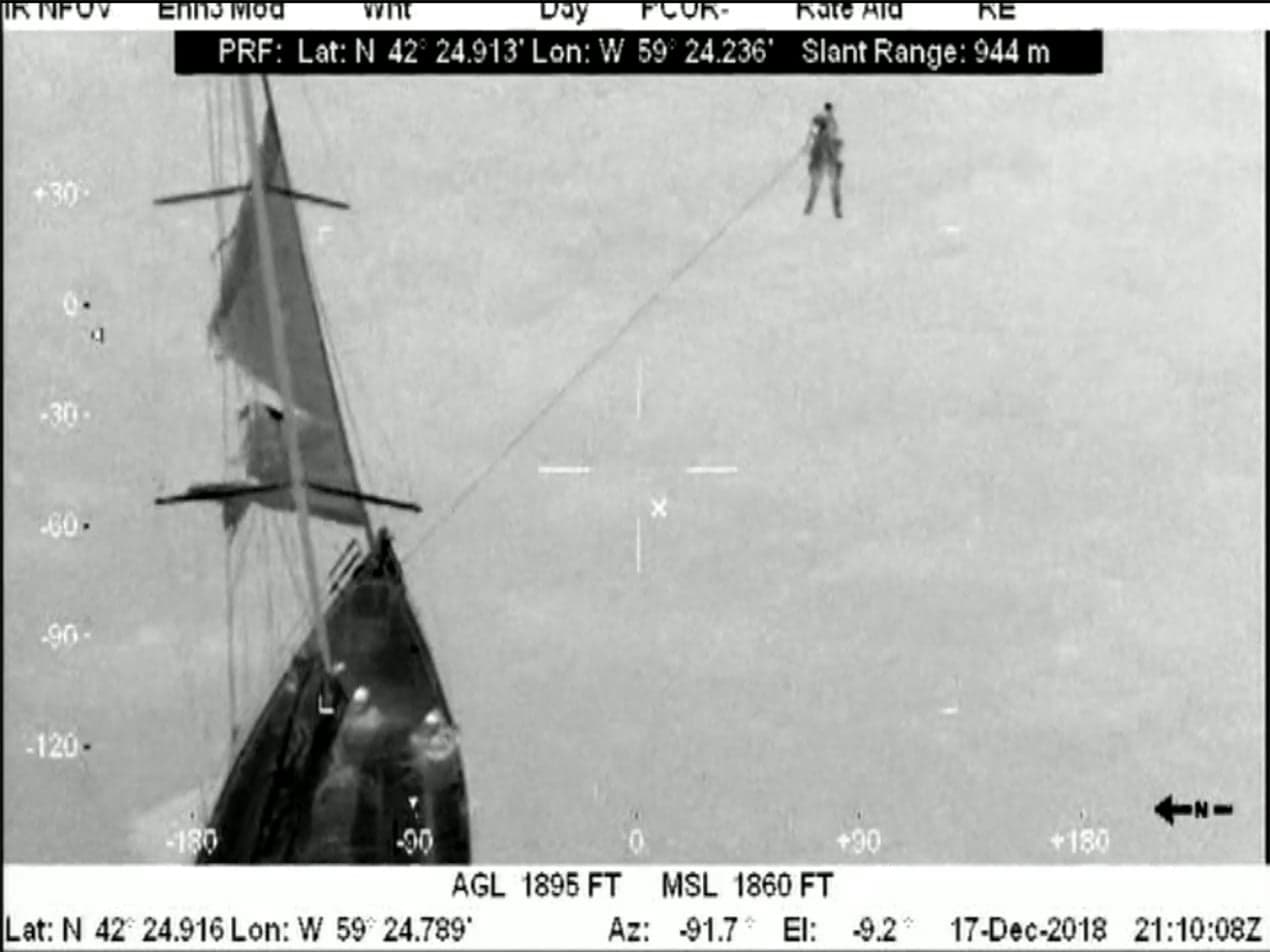
The search-and-rescue team boards the Makena. (Courtesy of the Canadian Armed Forces)
With two Makena crew still on the boat, darkness had fallen and the Cormorant faced a new challenge. They were getting low on fuel. “At the rate we were going, there was a very real chance we would have to leave someone behind,” Lebel wrote. Van Wagoner tells Maclean’s the crew was constantly monitoring what they call “Bingo” time—how long they could stay in the air with remaining fuel before fleeing for a safe landing. A night’s stay on Sable Island, the narrow strip of land about 300 km southeast of Halifax with two helipads and basic facilities, was a possibility.
The Royal Canadian Air Force’s fleet of Cormorant helicopters carry six crew: an aircraft captain, a first officer, two flight engineers and two search-and-rescue technicians. On Dec. 17, the Cormorant commanded by Capt. Jeff Powell, based at 413 Transport and Rescue Squadron in Greenwood, N.S., was near Port Hawkesbury on the way to overnight training on Cape Breton Island. Powell’s crew was also on-call for search and rescue duty. They got that call, refuelled at a nearby airport, and headed out to sea.
The Cormorant crew huddled and came up with a plan: Lebel would lower Nisbet, 120 feet onto the deck of the Makena using a cable hoist. The other Search & Rescue technician, Master Cpl. Gabriel Ferland, would follow and they’d team up to safely extract each crew member. Meanwhile, the aircraft would have to orient itself in such a way that Powell, the pilot, couldn’t actually see the Makena. He relinquished control of the Cormorant to the second flight engineer, M. Cpl. Justin Van Wagoner, who used a device called the hover trim control to maintain the helicopter’s position. As Lebel focused on lowering Nisbet and Ferland to the boat, Van Wagoner—who was on his first day back at work after a long absence from injury—kept the Cormorant steady.
Lebel marvelled at his colleagues’ stamina as they fought to find their footing. “The sailboat was moving in all directions, there were sails and a large mast moving around very fast and unpredictably,” he wrote. He praised Nisbet’s prolonged effort to pull Ferland onto the Makena after repeated false starts. “I cannot imagine the physical endurance and strength it took for Sgt. Nisbet to carry out this task for one hour and a half.” It took 40 minutes to get just the first evacuee up into the Cormorant and another 20 for the second.
Once they had a full tank, the crew set off for the Makena. When they arrived, the weather was less treacherous and visibility had improved. Lebel even recalls a bit of sunlight, but they were now racing against dusk in what were still roiling waters: the Makena would rise and fall up to 40 feet, and sometimes turn 45 degrees in the process. These conditions went well beyond routine training scenarios.“We have parameters that govern what we can do in training,” says Sgt. Bradley Nisbet, the Search & Rescue team leader. “We were pretty far outside that.”
Ninety minutes after the rescue operation got under way, Nisbet secured the collar around Maundrell and watched him climb into the sky. A few minutes later, Nisbet himself was the last off the boat, with all passengers secure. They flew off into the night, abandoning the Makena.
The sun had started to set, but it wasn’t yet dark enough for the Cormorant crew to strap on night-vision goggles. It was during that gloaming that Lebel, relying on hand signals from Nisbet and guidance from the pilot who was watching for large waves, attempted to lower Ferland. When he finally hit the deck, he and Nisbet started fitting the rescue collar over the cook. But just then a massive wave hit the boat, which dipped suddenly into the ensuing trough. Ferland was still attached to the hoist cable. Lebel attempted to pay out more cable but couldn’t keep up with the Makena’s rapid descent down the side of the wave. The cable went taut and jerked Ferland overboard; he landed about 20 feet from the boat. Lebel tried not to panic, pulling Ferland out of the water and manoeuvering to land him back on the deck. The rescue collar had actually slipped off the cook, so she remained aboard. Maundrell recalls Ferland “taking a terrible bloody beating” whenever he was lowered to the boat.
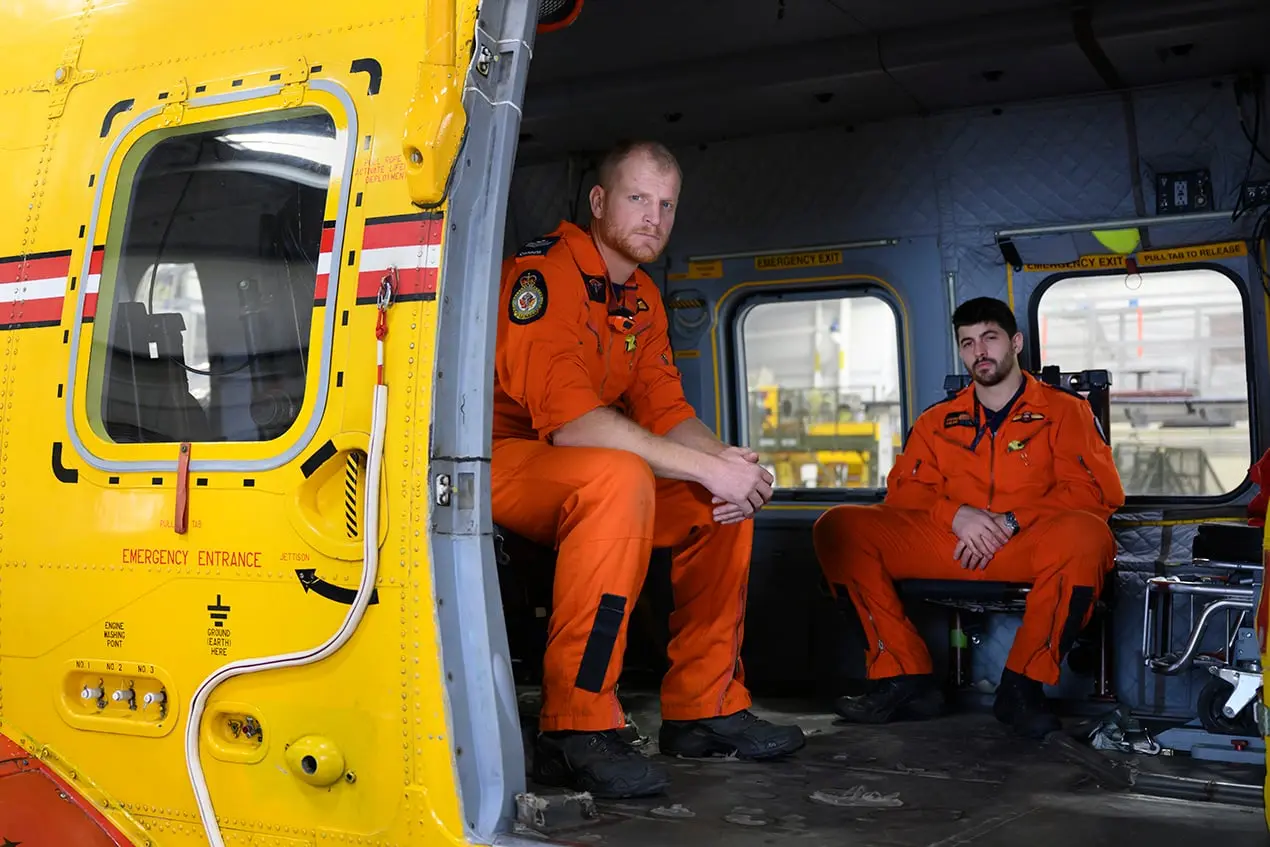
Nisbet and Ferland in a Cormorant helicopter at CFB Greenwood in Greenwood, N.S. (Photograph by Darren Calabrese)
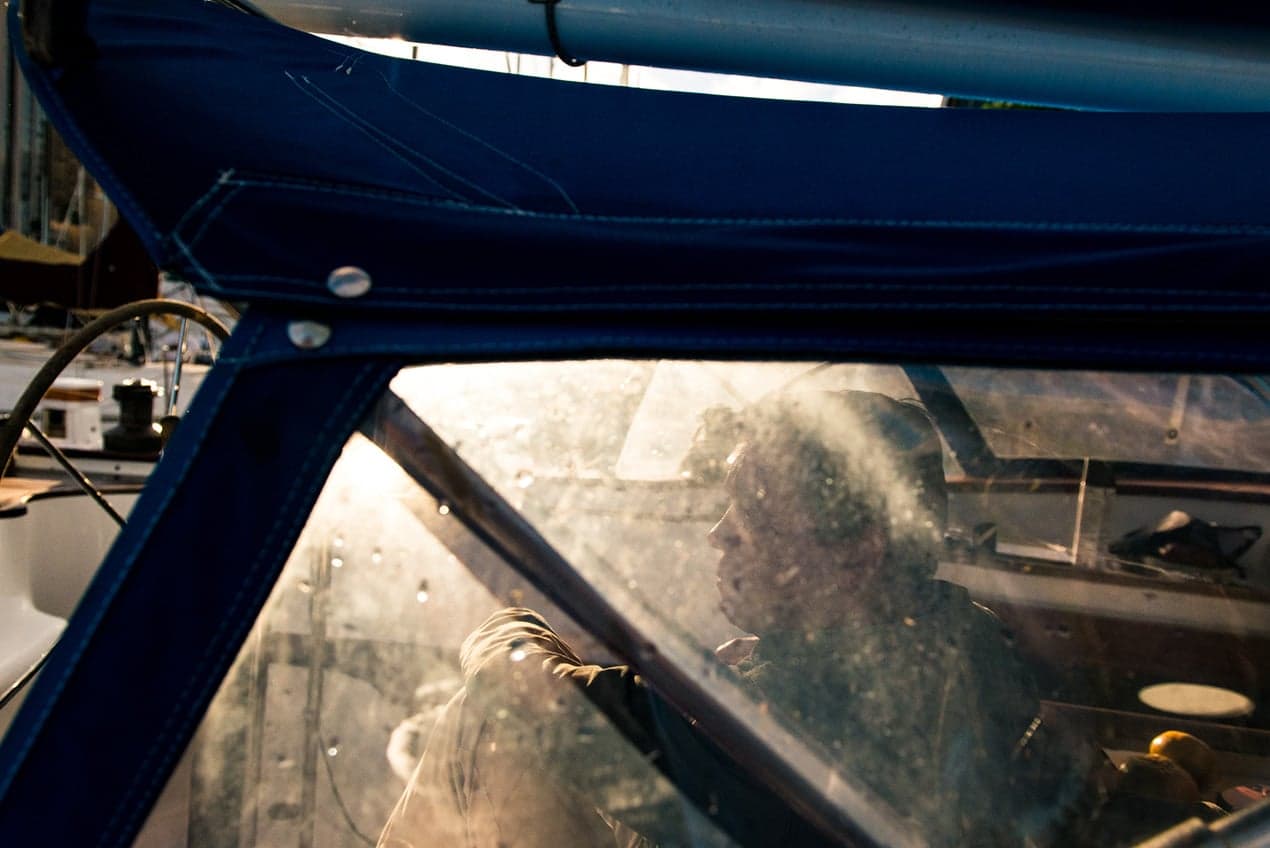
Maundrell takes a break at the Hawaii Yacht Club. (Photograph by Jenny Sathngam)
Maundrell describes suffering a severe depression, struggles that endure even a year later. “I think I’m fighting it at the moment, very much so,” he says over the phone from Charleston, S.C., during a short vacation. “It’s something that seems to have snuck up and bashed me on the back of the head.” He knows he did everything right. Hagen got the insurance payout and purchased another boat (this one arrived on a container ship); his Caribbean dreams are still on track. But for Maundrell, the bad dreams and second guesses linger. His only remedy is to set sail, once again, on the open seas.
Nisbet was exhausted. On board the Cormorant, he watched as Ferland—who never missed a beat even after he went overboard and had blood running down his face from one particularly vicious descent—check on the health and spirits of the Makena crew. “I was pretty smoked. I had to sit down for a second,” he says. “Then I watched [Ferland] get up, treating his patients. It was inspiring.” Lt-Col. Jean-Francois Gauvin was the commanding officer of 413 Transport and Rescue Squadron, the home of the Cormorant crew. Shortly after the rescue, he received an email from a colleague whose name is redacted: “Great work Frank. Early Christmas miracle.”
The rescue of the Makena was officially a success. The four souls aboard were saved. They abandoned ship having lost most of their possessions, even their shoes—they had to trudge through snow to a Halifax mall the next day, in their stocking feet, to buy more. But they all returned home with their lives. For six months, none of it bothered Maundrell. He met Hagen at a restaurant near Toronto’s Pearson airport on the way back home to the United Kingdom. He felt awful, but Hagen assured him he felt no ill will. Maundrell continued on with his life. It was only the next summer when memories of the Makena returned with a thud.
The Makena, off the coast of the Azores on May 1, 2019. (Courtesy of Maritime Rescue Coordination Center Delgada)
No one knows where the Makena is today. Maundrell didn’t turn off the boat’s tracking transponder, which conked out somewhere off Cape Cod on the Massachusetts coast. The boat then apparently caught a ride on the transatlantic Gulf Stream toward the Azores, where Le Boreal spotted it more than five months later. Twenty days after that sighting, a freighter spied the Makena on the other side of the Azores, suggesting it slipped through a channel between the islands. That was the boat’s last known whereabouts.
Unless another vessel happens to spot it, the boat could be lost forever, even if it remains afloat. Maundrell, for one, sees no reason the yacht should sink. He battened all the necessary hatches. His only undelivered boat, the one he watched disappear into the night, might still be bobbing around the North Atlantic, without a skipper or a mast, perpetually sailing its never-ending final voyage.
David Boghurst, the adjuster who monitors the case for the Makena’s insurer, told Maclean’s the file remains open, but that the yacht is “effectively a needle in a haystack;” his team “would be surprised if she remains afloat.” Richard Seager, a research professor at the Lamont-Doherty Earth Observatory of Columbia University, says the Makena would be “near impossible” to track even with precise ocean current data. Someone with a lot of expertise in ocean modelling might be able to do the job—but of all the lost vessels on the world’s oceans, the Makena isn’t likely to attract that kind of attention.