Tiny Soccer Pitches Are Taking Over
I started playing soccer as a kid, in my hometown of Brampton—but it wasn’t until I was 11, after the U.S. hosted the 1994 World Cup, that I went really wild for it. My dad got some two-by-fours and built some very small nets, which we set up right on the street in front of my house. My friends and I thought they were the best thing since sliced bread. There were kids in my neighbourhood from all over the world, whose parents hailed from countries where soccer was a much bigger deal than in Canada, and they all wanted to play, representing their countries.
Related: Good Luck Getting World Cup Tickets
Eventually, we planned a big tournament: a World Cup of our own. This time, we wanted to play on a proper pitch, and there was one near my house. It was bumpy, so we rented a lawn roller from Home Depot and just literally walked the field, thinking it would flatten it. I don’t even know if it did anything. But we had our tournament. There was Team Trinidad with me and one of my cousins. We had Italy and Portugal. We had Team Canada. There was a group of kids that were just Team World. Everyone put in five or 10 bucks for the winning team as a prize.
As a teenager, I started training seriously. A few years later I was invited to Europe, on trials for teams there. I was in Italy, in 2000, when the difference between Canadian and European soccer cultures really stood out to me. I’d been there for around two months, training in the city of Cagliari. Just around the corner they had a small pitch, all boxed off. It was like a cage. But every single night it was full of kids playing. Right after school, they’d head straight to these caged pitches, and they would just play day and night—all the kids in the community. And the ability level was high.
I realized that playing in these types of small pitches, you get a lot more touches on the ball. You don’t have to cover big distances, so you’re always finding ways to get on the ball and finding someone around you. You have to play the ball and move. I always loved playing in tight spaces as a kid. It prepares you as a player for the big field.
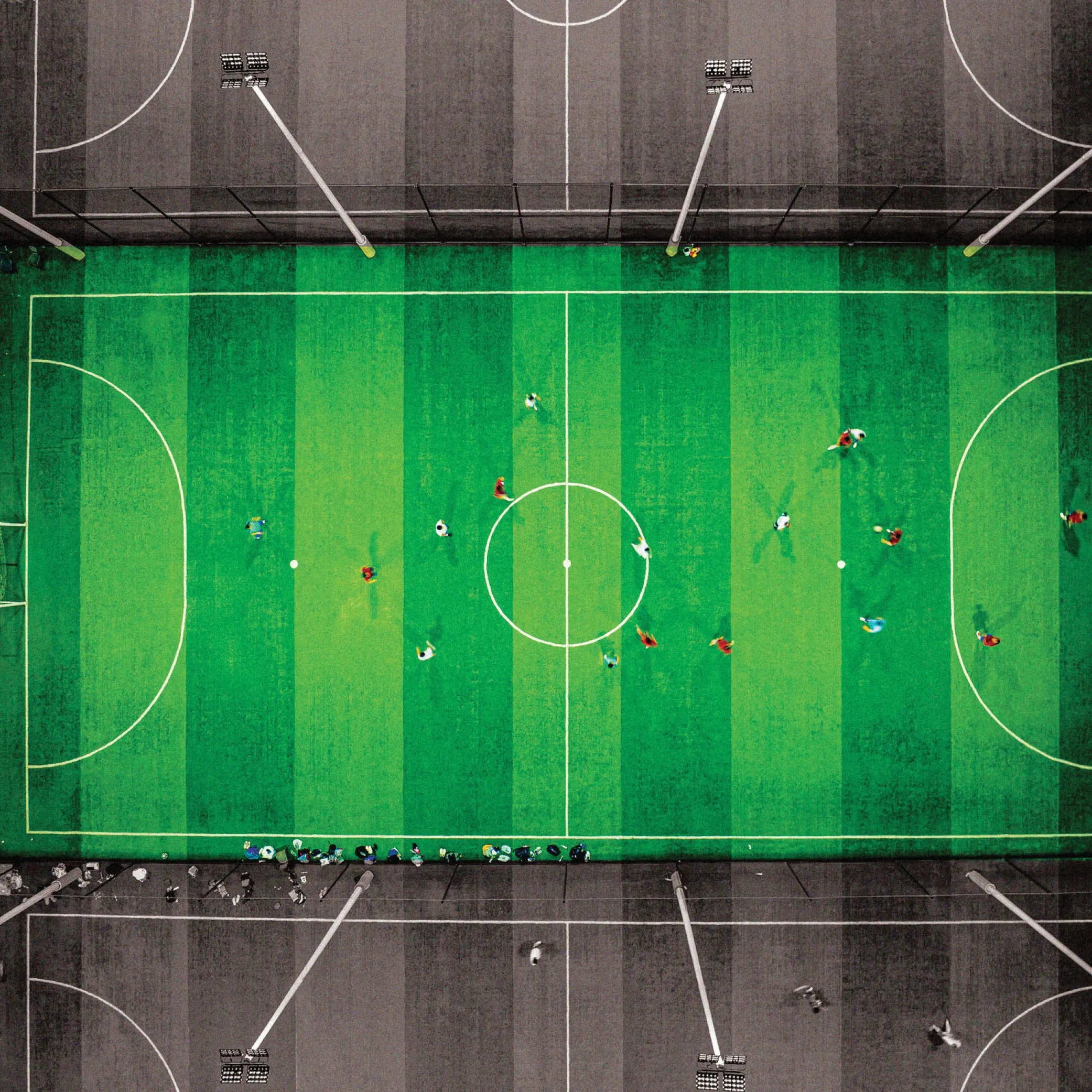
Shortly after I went pro in 2002, at age 19, I signed for teams in Europe. First, I played in Sweden on Östers IF, then on Helsingborg IF. Next, I played in Denmark for F.C. Copenhagen, and by 2010, I was in the Netherlands playing for PSV Eindhoven. The Netherlands is when I started seeing more of these small pitches everywhere—like, on every block. Many of them were built by the Johann Cruyff Foundation, an organization started by the Dutch soccer player of the same name. These mini pitches can be squeezed into urban areas easily, at relatively low cost. They provided constant access—kids could practise their skills day and night and head down right after school or from their homes, rather than compete for space on the limited number of full-sized pitches. Like the ones in Italy, they looked like boxed cages, and there were a lot of them. Any time there was a player of the year, they would build a court in the player’s hometown and name it after them. The idea was to put something in the community that was targeted at kids and also showed respect.
This kind of small-scale, inexpensive youth sports infrastructure produces great players—the small-sided game in Holland is one of the best, and they have some of the best technical players, which I attribute partly to these pitches.
I finished my professional career in 2023 in Turkey, where they also have mini-pitches. Around that time, I was talking with my old friend, Alex Della Sciucca, who’s also from Brampton. We’d played together in all those local tournaments years ago and had kept in touch ever since. I was thinking, what can we do for our community? I knew it was almost the end of my career, and I wanted to find ways to give back. I wanted to help develop the game, not just in Canada, but in the city where I’m from.
In Brampton, there were parks and soccer fields everywhere. We thought it’d be cool to start building mini-pitches, where young players could have so many more touches on the ball. They’d be easy to build, inexpensive and accessible.
Related: How Diana Matheson Built a Pro League for Women’s Soccer Stars
The city of Brampton told us it was putting in a youth facility at Century Gardens, a large community hub where we had some of our best games as kids. We thought that would be the perfect spot for our first pitch. It’s not just about developing great players, but getting young people off their devices and out somewhere they can play. There was a lawn-bowling facility at Century Gardens; we told the city that no one does lawn bowling anymore. So that’s where we built the Atiba Hutchinson Soccer Court, the first fully lit boxed soccer court in Canada. It opened in 2024.
The lights are solar-powered. The pitch is artificial turf, with a boxed net on either end. It’s surrounded by sport fencing, which is more forgiving than a regular fence: you can bump into it and play the ball off it. We had a tournament at Century Gardens, and it was my first time touching the ball since I retired. It was a special moment: I felt like a kid again. And I think everybody around was proud, too, of seeing the whole setup and the energy that it gave everybody. We played the tournament games on the big field and did sudden-death matches for ties in the boxed court. We brought together the same guys we played with when we were young, as well as our families.
Last year, we approached the city of Toronto about building more mini-pitches. We’re now developing at least four there, which will open after the World Cup this summer. They’re at Apted Park, Amesbury Park, Grandravine Park and Scarborough Village Park.
We’re also working with Canadian Tire’s Jumpstart Charities to build more mini-pitches across the country. We’re part of a partnership building one at Toronto’s Harbourfront and another in Surrey, B.C. We hope to expand to hundreds of towns and municipalities. That’s how the game is going to grow.
You always see people shovelling the snow off the ice in Canada—they find a way to play hockey. I know firsthand you can play soccer in the cold. And the whole world saw the Canadian brand of soccer on display during the snowy championship game for the Canadian Premier League in Ottawa last year. Alex and I joke that we’ll know the sport is growing here when kids are going to a mini-pitch in January, shovelling the snow off the courts, because they love it that much.
- As told to Angus MacCaull
What did you think of this story? Send a comment for publication to letters@macleans.ca, and supply your name and address. Comments should be fewer than 200 words, and may be edited for length and clarity.
Get the Best of Maclean’s straight to your inbox.
Sign up for news, commentary, analysis and promotions. Join 80,000+ Canadian readers.